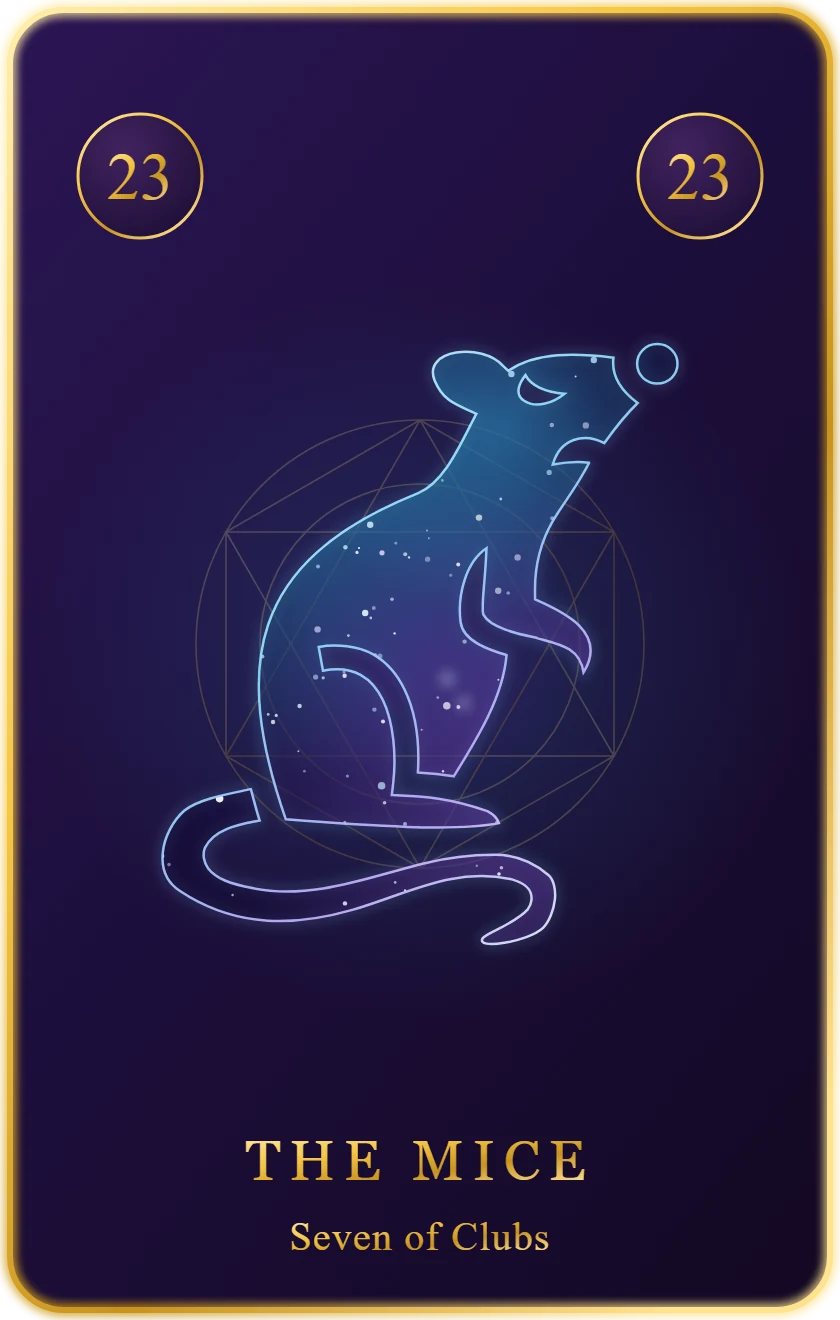
Meaning
The Mice carry a very precise word, and that word is wear. Not the clean break, not the spectacular loss: the slow diminishing, the one that works in silence and is noticed only once the count is done.
That is what sets card 23 apart in the deck. Where the Scythe cuts in one stroke, the Mice nibble. The imagery of the Dondorf line, around 1890, says it plainly: two or three mice on the ground, busy gnawing, with no staging at all. Nothing dramatic, just continuous work removing matter.
The Petit Lenormand is literal, and this card more than others. It asks for no deep interpretation: it designates what is wearing down in the area indicated by its neighbour. A budget that leaks, health that crumbles, patience that runs out, an object that goes missing. The mechanism stays the same, only the ground changes.
Three registers come up most often. The material first: small invisible expenses, repeated leaks, mislaid things. The physical next: fatigue, insufficient sleep, energy dropping with no identified cause. The relational last: weariness, accumulated irritations, a bond losing density without a single argument being declared.
A point of method, valid throughout the deck but decisive here. A single card gives one word, not a reading. The Mice on their own say neither what is wearing down nor how far. They supply the verb, the neighbour supplies the subject. Without a neighbour, the sentence stays unfinished.
Finally, the Mice announce nothing. They name a movement of diminishing already under way at the time of the spread. That is in fact their most useful function: putting a name on an erosion that habit had made invisible.
Playing card and traditional reading
The Mice carry the inset of the Seven of Clubs. This correspondence comes from the thirty-six card piquet deck that originally doubled the Petit Lenormand, and it is stable in the Dondorf line.
In the German school, the Clubs suit points to the concrete and the everyday: work, running costs, what repeats each day. Applied to the Mice, it places the card on the side of ordinary wear, the wear of habits and small things, rather than of a collapse. The low rank goes the same way: the scale is modest, but the action is continuous.
Some modern editions no longer print this inset and replace it with a verse or with nothing at all. The correspondence remains valid for the reading, it is simply absent from the artwork.
Key combinations
Meaning is born from the pair, not from the card alone. The grammar is fixed: the first card is the noun, the second the qualifier. The Mice followed by the Ring speak of a commitment wearing thin; the Ring followed by the Mice frames the same scene differently, starting from the bond.
| Combination | Reading |
|---|---|
| The Mice + The Fish | Expenses that nibble away, a financial erosion |
| The Mice + The Heart | A feeling wearing out, an emotional weariness |
| The Mice + The Tree | Physical fatigue, energy dropping |
| The Mice + The House | A home falling into disrepair, charges that weigh |
| The Mice + The Ring | A commitment wearing thin, a contract emptying out |
The full mechanics of pairs are set out on the page about reading by combinations.
Position in the Grand Tableau
In a Grand Tableau, each place carries the meaning of the card whose number it holds. Position 23 is therefore the house of the Mice: what wears down, what is quietly lost.
The card that lands there indicates the ground of the erosion. The Fish in the house of the Mice point to finances, the Tree to health, the Fox to work. And when the Mice fall in their own house, the word is doubled: wear is the subject itself, not a side effect.
The three tableau formats and the table of the thirty-six houses are set out on the page about the Grand Tableau.
Keywords
| Register | Words |
|---|---|
| Core meaning | What diminishes little by little without being noticed |
| Material | Wear, gradual loss, nibbling, leakage, invisible spending |
| Physical | Fatigue, slow exhaustion, energy dropping |
| Relational | Weariness, irritation, a bond emptying out |
| Rhythm | Continuous, slow, underground |