Meaning
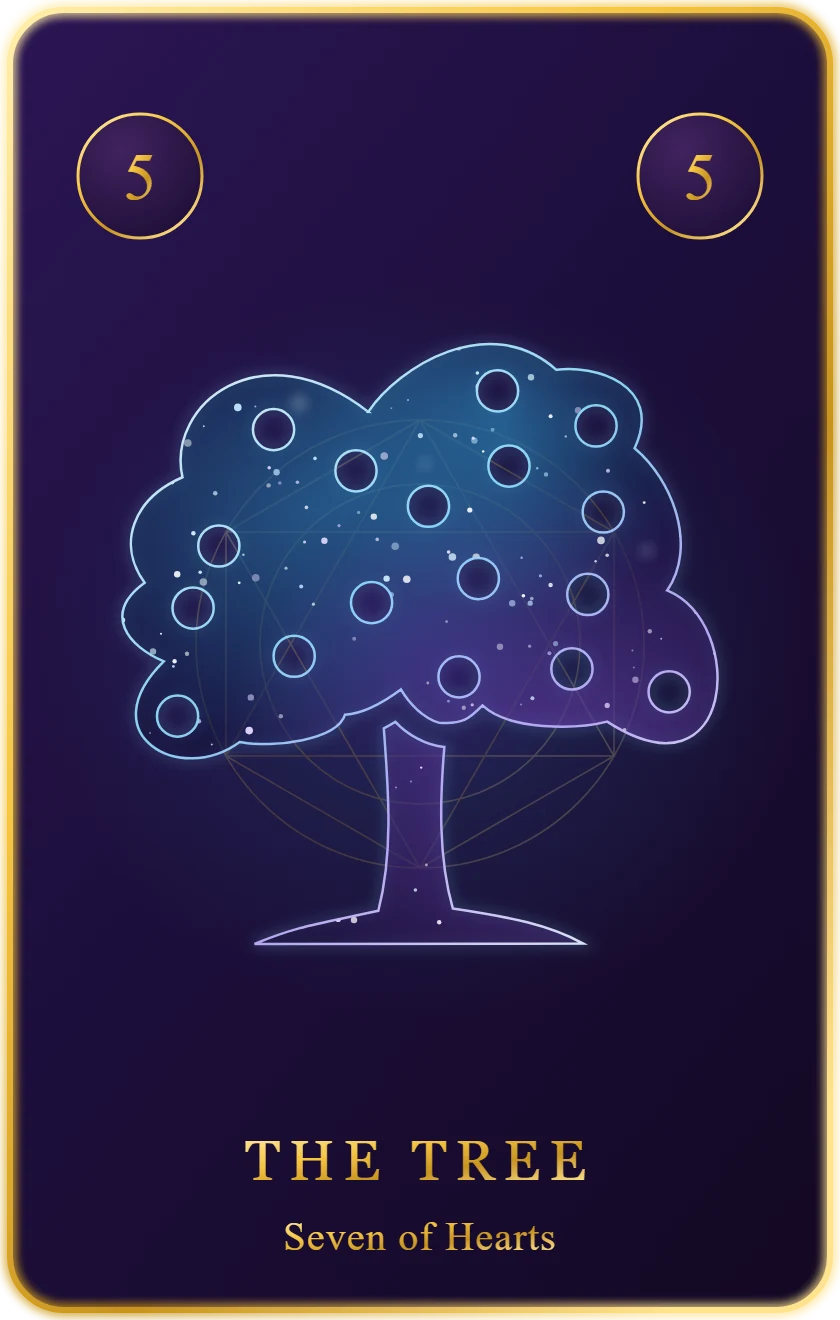
The Tree is card 5 of the Petit Lenormand, and its word rests on a simple image: what grows slowly and holds by its roots.
Two areas follow from that. The first is the body: health, vitality, general physical condition. It is the health card of the deck, the one you look at first when the question is about fitness or recovery. The second is lineage: family roots, what comes from far back, what has been handed down without being chosen.
These two meanings are really one in the logic of the deck. A tree is a living thing that stands because it is planted somewhere. Health here is not a one off state, it is what builds over time and depends on what lies underneath.
The Lenormand stays literal: the Tree does not stand for spiritual growth, it names a slow and living process. A single card never provides a reading anyway, only that word. And on health questions the card indicates the area concerned, never a diagnosis. It is in no way a substitute for medical advice.
On decks of the Dondorf line, around 1890, the card shows a single leafy tree with a broad root system. What the imagery underlines is the mismatch between what is visible and what holds: the trunk can be seen, the roots cannot. The Tree often speaks of what acts deep down and only shows up late.
Pace is part of the meaning. The Tree is slow, it knows nothing of urgency. On a question of timing, its presence leans towards the long, towards a process in stages rather than a sudden shift. That is also what makes it reassuring: what grows slowly does not vanish all at once.
Playing card and traditional reading
The Tree carries the inset of the Seven of Hearts. This correspondence comes from the thirty-six card piquet pack that doubled the Petit Lenormand at the outset.
In the German school, the suit of Hearts anchors the card in the living and in bonds. It explains the double reading of the Tree: the body on one side, family and transmission on the other. It is a warm card, without the roughness the suit of Spades brings, and that warmth turns its reading towards care rather than constraint.
Some modern editions do not print this inset. The correspondence still holds for the reading, it is simply absent from the artwork.
Essential combinations
Meaning is born from the pair. The grammar is fixed: the first card is the noun, the second the qualifier. The Tree followed by the Mountain speaks of health running into an obstacle. The Mountain followed by the Tree speaks of an obstacle that lasts and takes root, which is not the same sentence.
| Combination | Reading |
|---|---|
| The Tree + The Cross | A health ordeal, a burden weighing on the body |
| The Tree + The Sun | Vitality returns, a bright recovery |
| The Tree + The House | A family story, an inheritance of lineage |
| The Tree + The Mountain | A slow convalescence, an obstacle blocking recovery |
| The Tree + The Stars | Guided growth, a health path that grows clearer |
The full mechanics of pairs are set out in reading by combinations.
Position in the Grand Tableau
Position 5 of a Grand Tableau is the house of the Tree: health, what grows with time.
The card that lands there indicates what touches vitality or what is taking root. The Mice in the house of the Tree point to fatigue settling in, the Sun to energy coming back, the Anchor to a stable and lasting physical condition.
The table of the thirty-six houses and the three tableau formats are set out on the Grand Tableau page.
Keywords
| Register | Words |
|---|---|
| Core meaning | What grows slowly and holds by its roots |
| Body | Health, vitality, physical energy, convalescence |
| Origin | Roots, lineage, transmission, family inheritance |
| Pace | Slow, gradual, in stages, lasting |