Meaning
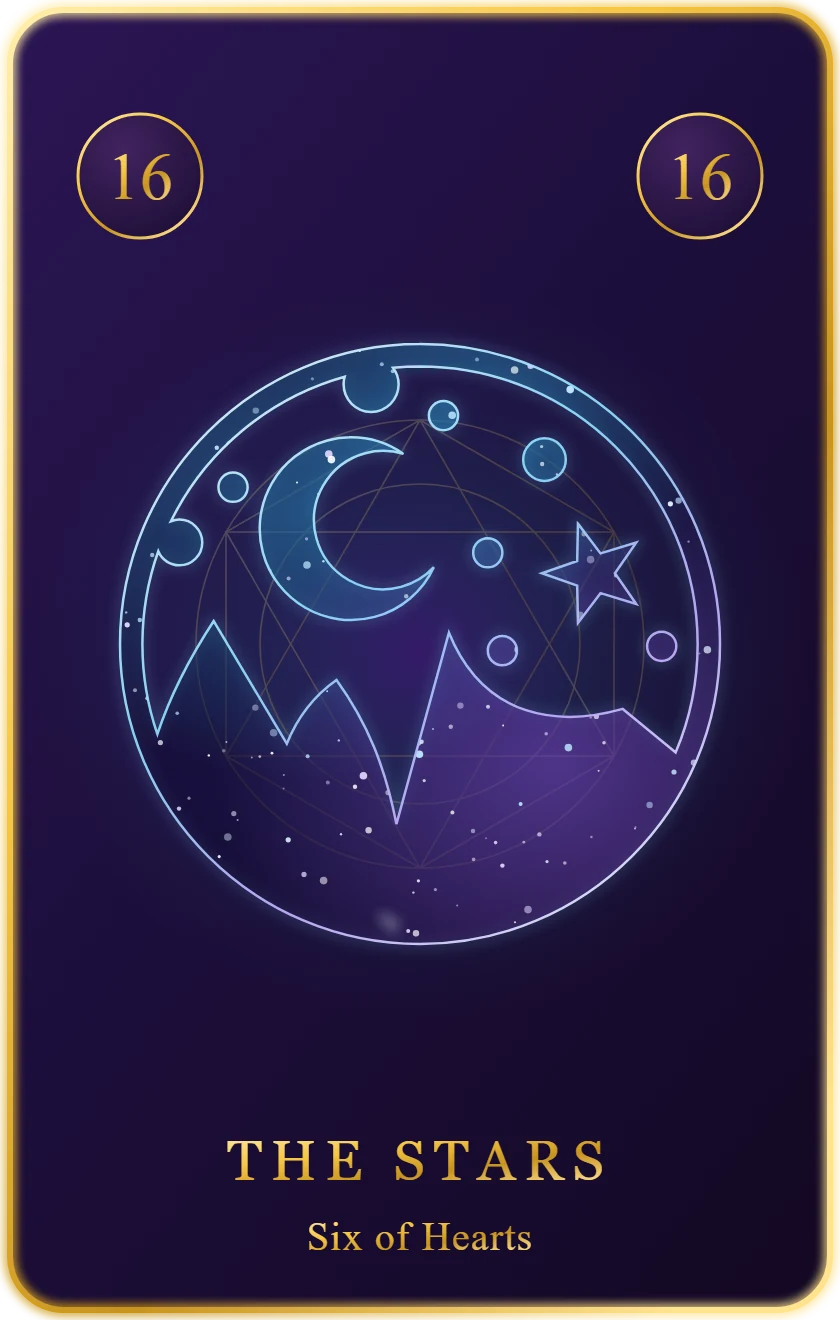
The Stars are card 16 of the Petit Lenormand, and their word takes very little space: what orients. A star is looked at from very far away. It gives a direction and says nothing about the ground to be crossed. That is exactly the reach of the card: it indicates the bearing, never the itinerary.
Not to be confused with the Star of the Tarot de Marseille. Two systems, two vocabularies. In tarot, the Star is a symbolic figure to be contemplated, loaded with hope and destitution. In the Lenormand, the Stars are literal: they name orientation and clarity of bearing, what you are heading towards and what stays visible above the situation.
On decks of the Dondorf line, around 1890, the card shows a night sky broadly sown with stars. The detail matters: there are many of them. From that come the two sides of the word. The first is clarity: the sky is clear, the landmark can be seen, you know which way to move. The second is scattering: when everything shines, nothing stands out any more, and attention breaks up between too many equivalent possibilities.
The area of life concerned is that of bearing: the orientation of a project, a professional direction, a long term choice, whatever gives a line to a period. The Stars do not speak of results. They do not say whether you arrive, they say whether you know where you are going.
A note on method is needed here. On its own, the card gives a word and nothing more: there is a landmark, or it is blurred. It is the neighbour that settles between the two sides. With the Clouds, the bearings get muddled. With the Sun, the course is held and visible. The Stars stay neutral by construction, like most cards in the deck.
Playing card and traditional reading
The Stars carry the inset of the Six of Hearts. This correspondence comes from the thirty-six card piquet pack that doubled the Petit Lenormand at the outset, and it is stable in the Dondorf line.
In the German school, the suit of Hearts turns the reading towards feeling and towards what touches a person directly. Applied to this card, it gives a useful nuance: the bearing the Stars speak of is not a cold objective, it is a direction that matters to the person. You orient yourself towards what counts, not towards what pays.
Some modern editions, in particular contemporary artist decks, do not print this inset. The correspondence still holds for the reading, it is simply absent from the card artwork.
Essential combinations
The Lenormand is read in pairs, and the grammar is fixed: the first card is the noun, the second the qualifier. The Stars followed by the Clouds do not say the same thing as the Clouds followed by the Stars. In the first case, the landmark is what gets blurred. In the second, confusion is what begins to clear.
| Combination | Reading |
|---|---|
| The Stars + The Crossroads | An informed choice, the right direction takes shape |
| The Stars + The Clouds | Blurred bearings, an uncertain orientation |
| The Stars + The Sun | A fully visible success, a course held |
| The Stars + The Book | Knowledge that lights the way, a study that orients |
| The Stars + The Key | The direction is the right one, the path is confirmed |
The full mechanics of pairs are set out in reading by combinations.
Position in the Grand Tableau
Position 16 of a Grand Tableau is the house of the Stars: what guides, the horizon aimed at.
The card that lands there indicates what the person orients by, or in which area they are looking for a landmark. The Book in the house of the Stars points to knowledge serving as a compass, the Mountain to a bearing that is hard to keep in view. When the Stars fall in their own house, the landmark is clear and the direction is owned.
The table of the thirty-six houses and the three tableau formats are set out on the Grand Tableau page.
Keywords
| Register | Words |
|---|---|
| Core meaning | What orients from afar, without giving the detail of the road |
| Clarity | Landmark, visibility, clear sky, legibility |
| Orientation | Bearing, direction, line followed, horizon aimed at |
| Hope | What one moves towards, what gives a line |
| Reverse side | Scattering, dispersal, too many directions at once |