Meaning
The Book names what is written but not yet opened. A secret, information that exists without being shared, knowledge in the process of being acquired. Card 26 marks a border: on one side what is known, on the other what is not known yet.
Its central word is therefore double, and both faces hold together. The secret first: something is kept aside, deliberately or not, and the spread signals it without revealing its content. Learning next: a course, studies, a skill built page after page. In both cases there is content enclosed in an object, and a reader who does not yet have access to it.
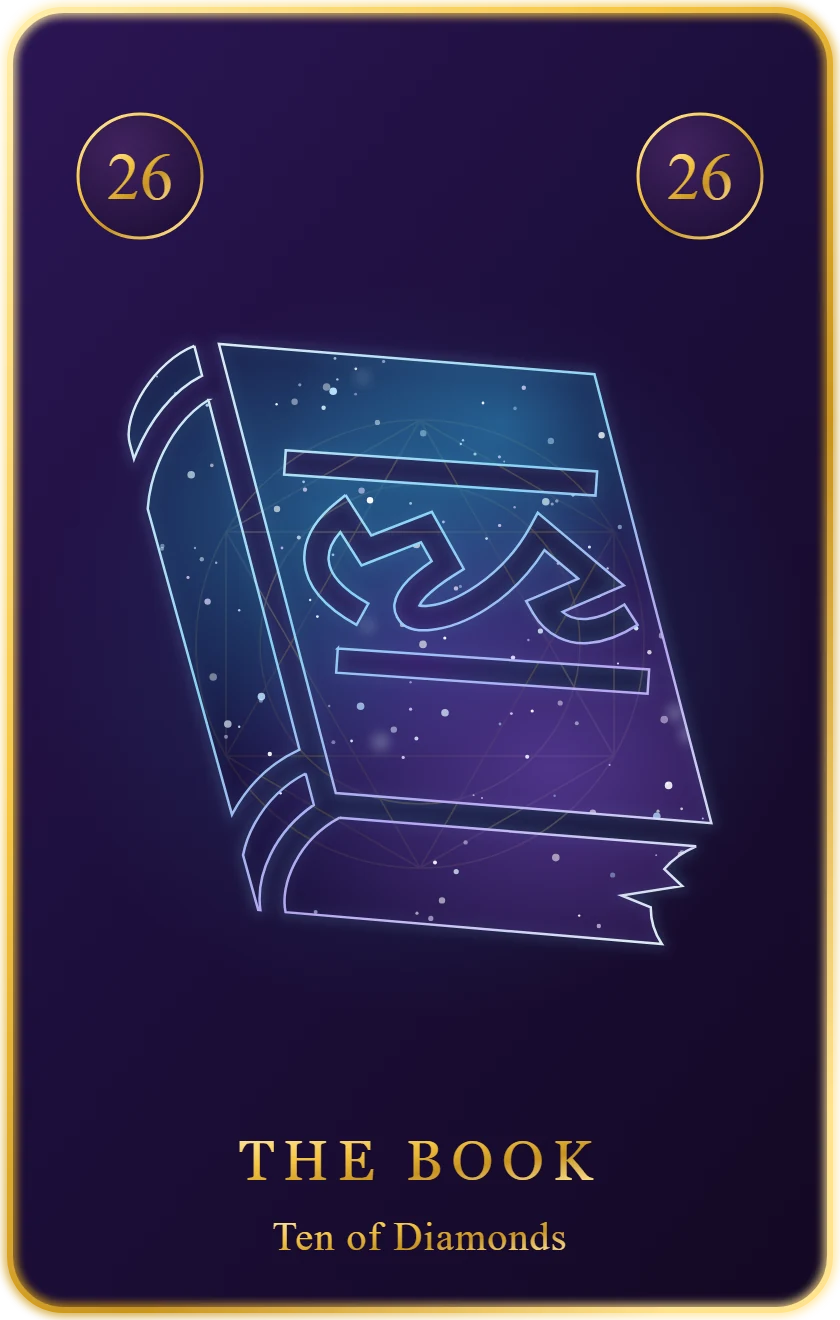
The imagery of the Dondorf line, around 1890, makes it visible at a glance. The book is often shown closed, sometimes set on its edge, sometimes half open depending on the edition. Some practitioners read the orientation of the volume, but that nuance is in no way systematic and depends on the deck: better to rely on the neighbours than on the drawing.
The Petit Lenormand is literal. The Book does not ask you to look for hidden wisdom in it: it designates unavailable information. In a question about a couple, it names what has not been said. In a question about work, a file, a skill to acquire, a procedure you do not know. In an administrative question, a document that exists somewhere.
A point of method: a single card gives one word, not a reading. The Book in isolation says neither who keeps the secret nor whether it will be opened. It sets out the idea of enclosed content, and waits for its neighbour. The Key is the card that opens it most clearly.
Finally, the Book promises no revelation. It records that part of the situation remains out of reach at the time of the spread, which is already useful information.
Playing card and traditional reading
The Book carries the inset of the Ten of Diamonds. This correspondence comes from the thirty-six card piquet deck that originally doubled the Petit Lenormand, and it is stable in the Dondorf line.
In the German school, the Diamonds suit points to what is counted, documented and circulates: information, papers, measurable values. Applied to the Book, it leans towards the file, the study and the document rather than towards the intimate secret. The high rank goes the same way: a dense volume, content that carries weight.
Some modern editions no longer print this inset and replace it with a verse or with nothing at all. The correspondence remains valid for the reading, it is simply absent from the artwork.
Key combinations
Meaning is born from the pair. The grammar is fixed: the first card is the noun, the second the qualifier. The Book followed by the Key speaks of a secret opening up; the Key followed by the Book speaks first of a confirmation, which knowledge then specifies.
| Combination | Reading |
|---|---|
| The Book + The Heart | A feeling kept secret, an undeclared love |
| The Book + The Key | A secret revealed, knowledge opening up |
| The Book + The Fox | Professional training, a trade skill |
| The Book + The Child | Learning that begins, first notions |
| The Book + The Tower | An administrative file, official archives |
The full mechanics of pairs are set out on the page about reading by combinations.
Position in the Grand Tableau
Position 26 in a Grand Tableau is the house of the Book: the secret, what remains to be learned.
The card that lands there indicates the area the missing information bears on. The Heart in the house of the Book points to an unexpressed feeling, the Fox to a skill to acquire, the Tower to an institutional file. And when the Book falls in its own house, the word is doubled: the reading runs up against what is not yet accessible.
The three tableau formats and the table of the thirty-six houses are set out on the page about the Grand Tableau.
Keywords
| Register | Words |
|---|---|
| Core meaning | What is written but not yet opened |
| Secret | The unsaid, withheld information, confidence, hidden part |
| Knowledge | Learning, training, studies, skill |
| Document | File, archive, text, content to consult |