Meaning
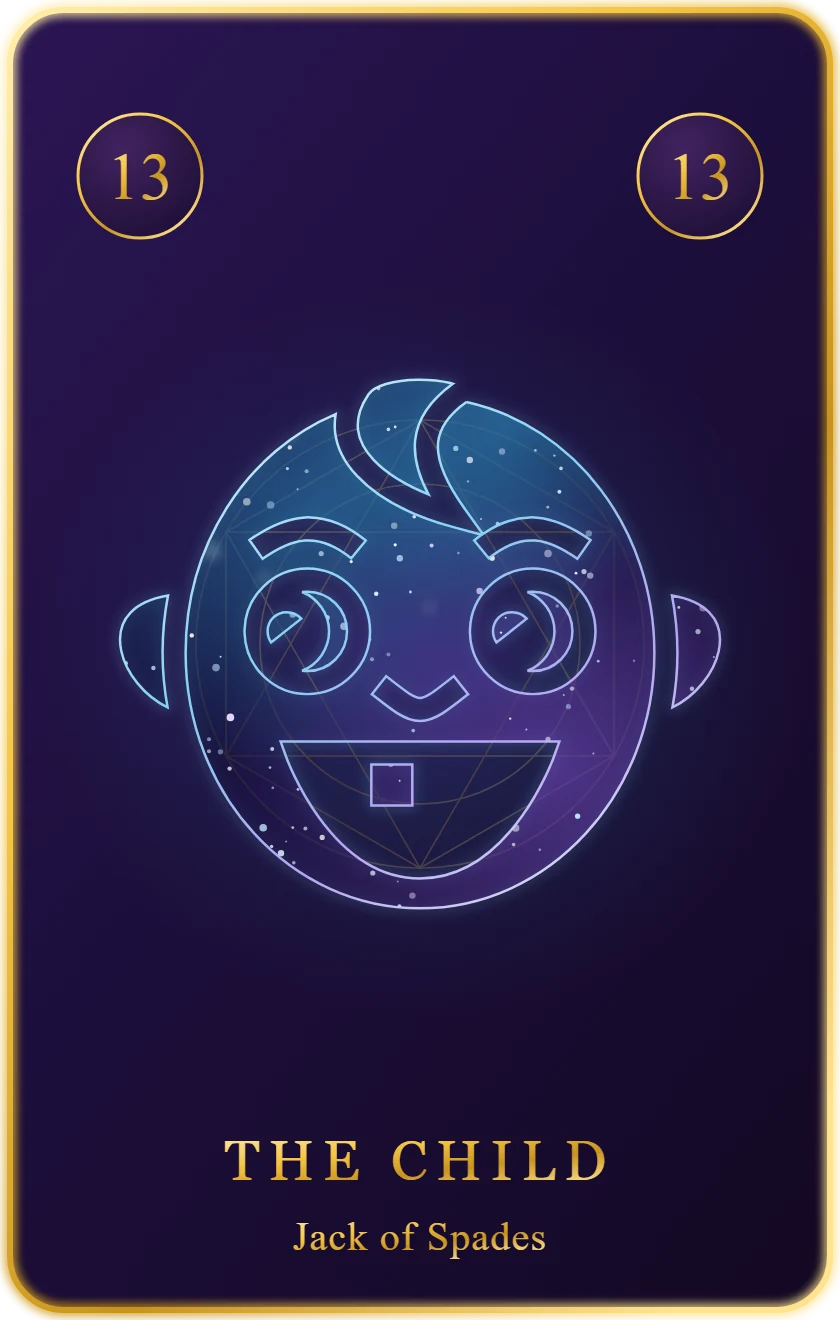
The Child is card 13 of the Petit Lenormand, and its word denotes a stage rather than a person: what begins. The start, the first step, what already exists but has not yet reached its size.
On decks of the Dondorf line, around 1890, the picture shows a child alone, standing or at play. It is not a figure to be interpreted as a character in the spread, except when the context clearly demands it. Most of the time the child shown stands for a property: small, new, still tender.
Four nuances come out of this word. The beginning first: a thing starts, it is in its earliest hours. Then novelty: this is unprecedented, never done before, without precedent in the person’s history. Also innocence: the lack of experience, the simplicity, sometimes the naivety of someone discovering. And finally small scale: a modest quantity, a limited reach, a reduced format.
That last nuance is very useful in reading, because it works as a graduation. The Child placed next to a card reduces its reach: it is not nothing, it is little. A sum becomes a small sum, a conflict becomes a friction, a project becomes a trial run.
Fragility is part of the word, and it should not be removed to make the card more pleasant. What begins is vulnerable, and nothing guarantees that it will grow. Nor does the card assert the opposite: it names a present state, young and not yet solid, without pronouncing on what follows.
Finally, the question that always comes up: the Child is not automatically read as a birth. It can denote an actual child when the question is about family, but it equally denotes a professional start, a relationship getting under way or a course of study beginning. A single card gives only a word: its neighbour is what settles the area.
Playing card and traditional reading
The Child carries the inset of the Jack of Spades. This correspondence comes from the thirty-six card piquet pack that doubled the Petit Lenormand at the outset, and it is fixed by the canonical table, never guessed from the name.
In the German school, the suit of Spades points towards the demanding register, towards what calls for effort or runs into resistance. The inset does not contradict the word of the card, it lights up one angle of it: a beginning takes energy, it exposes you to inexperience, and it is not yet protected by habit.
Some modern editions do not print this inset. The correspondence still holds for the reading, it is simply absent from the artwork.
Essential combinations
The Lenormand is read in pairs, and the grammar is fixed: the first card is the noun, the second the qualifier. The Child followed by the Fox and the Fox followed by the Child do not say the same thing. In one case a beginning concerns work. In the other, work is done on a small scale or with little experience.
| Combination | Reading |
|---|---|
| The Child + The Heart | A budding feeling, the start of a relationship |
| The Child + The House | A new home, a family growing |
| The Child + The Fox | A new post, a professional start |
| The Child + The Book | Learning that begins, a course of study |
| The Child + The Fish | A small sum, a modest financial start |
The full mechanics of pairs are set out in reading by combinations.
Position in the Grand Tableau
Position 13 of a Grand Tableau is the house of the Child: what is starting out, what is still small.
The card that lands there indicates what is taking its first steps and in which area. The Book in the house of the Child points to knowledge only just approached, the Anchor to a habit barely beginning to settle. When the Child occupies its own house, its word is reinforced: everything is new, and nothing is established yet.
The table of the thirty-six houses and the three tableau formats are set out on the Grand Tableau page.
Keywords
| Register | Words |
|---|---|
| Core meaning | What begins and stays fragile |
| Beginning | Start, onset, first step, getting under way |
| Novelty | Unprecedented, never done, without precedent |
| Scale | Small, modest, limited reach, innocence, inexperience |