Meaning
The Fish are the card of means. Card 34 of the Petit Lenormand names what circulates and is counted: money, resources, flows, everything that comes in and goes out. It designates an area, it does not judge what happens there.
The Lenormand is literal. The Fish are not a figure of abundance to meditate on, they are a word in a sentence, and that word is “money” in the broad sense: income, spending, assets, salary, cash flow. The neighbour says whether that flow is rising, falling or standing still.
A second register accompanies the first, and it is more interesting than it looks: independence. The Fish are traditionally tied to self employed activity, to trade, to what you earn by yourself rather than through a structure that pays you an income. The link between the two registers is direct: having your own means is having your own margin.
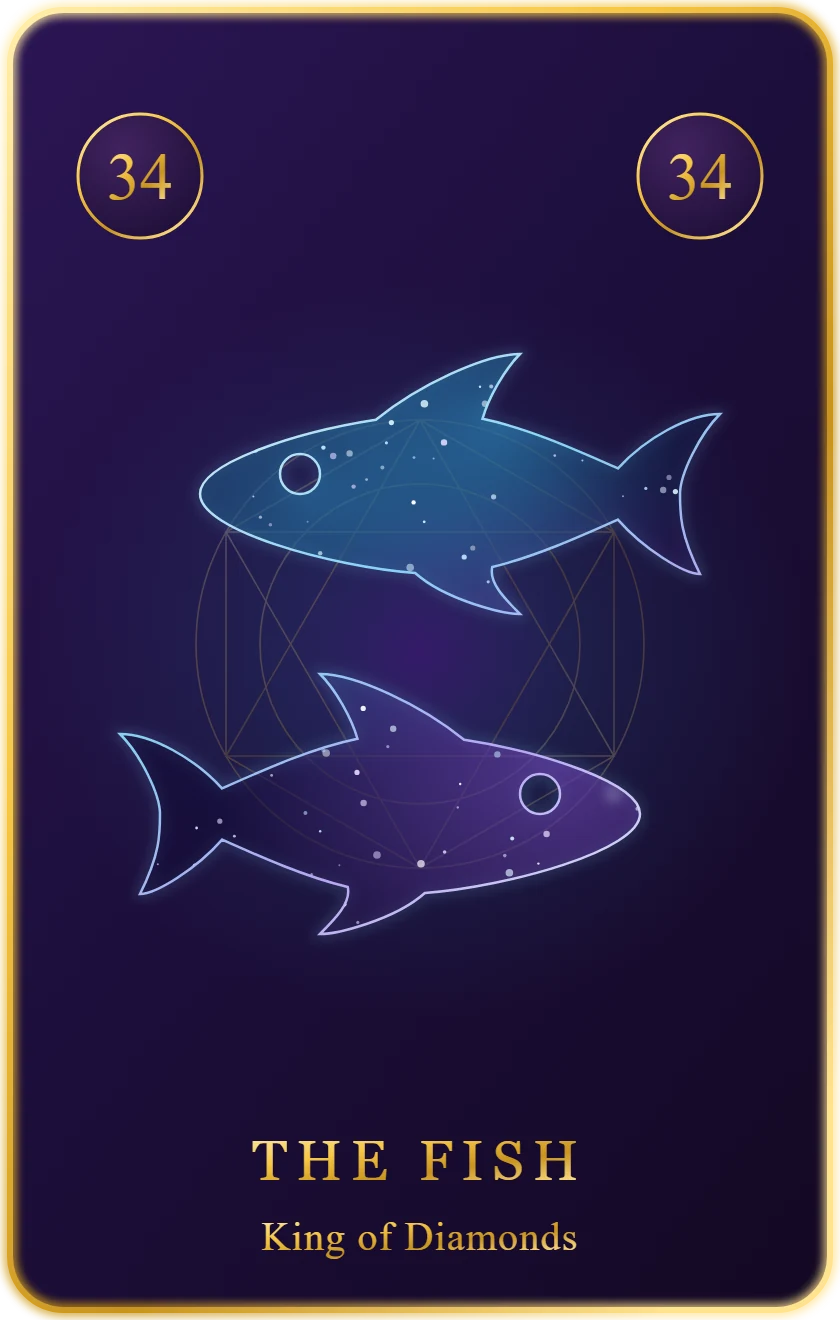
On decks of the Dondorf line, around 1890, the card shows several fish in water, sometimes with a barrel alongside. The plural and the water state the meaning better than the word does: what counts is circulation, not the sum.
One point of posture applies here more than elsewhere. The Fish do not promise a gain. They name the area where something is being counted, and signal that the question has a material dimension. Translating this card as a prediction of money coming in is the most common mistake of the module.
Quantity also deserves a nuance. The Fish speak of flow, not of stock. What circulates a great deal is not necessarily what remains: money passing through your hands is not money that accumulates. Once again it is the neighbour that decides between passage and reserve.
And like every card in the deck, taken alone it gives one word only. A card in isolation does not make a reading.
Playing card and traditional reading
The Fish carry the inset of the King of Diamonds. This correspondence comes from the thirty-six card piquet deck that originally doubled the Petit Lenormand, and it is fixed by the canonical table of the module, never deduced from the name of the card.
In the German school, the Diamonds suit is that of the concrete and the measurable: what is counted, verified, recorded in facts. Here it confirms the main meaning of the card rather than qualifying it. The rank of King adds scale and command: not a few coins, but means held in hand.
Some modern editions no longer print this inset. The correspondence remains valid for the reading, it is simply absent from the artwork.
Key combinations
The grammar of the Lenormand is fixed: the first card is the noun, the second the qualifier. The Fish followed by the Fox speak of the income that work produces, the Fox followed by the Fish speaks of work oriented towards money. The two pairs do not say the same thing.
| Combination | Reading |
|---|---|
| The Fish + The Fox | Income from work, salary |
| The Fish + The Bear | Capital, substantial resources |
| The Fish + The Mice | Financial losses, a budget being eroded |
| The Fish + The Anchor | A stable financial situation |
| The Fish + The Ship | Trade, money coming from far away |
The full mechanics of pairs are set out on the page about reading by combinations.
Position in the Grand Tableau
In a Grand Tableau, each place carries the meaning of the card whose number it holds. Position 34 is the house of the Fish: money, what circulates.
The card that lands there indicates where the means come from, or what weighs on them. The Fox in the house of the Fish points to income from activity, the Mice to a slow erosion, the Anchor to a situation that holds. And when the Fish fall in their own house, the financial subject is at the centre of the question.
The table of the thirty-six houses and the three tableau formats are set out on the page about the Grand Tableau.
Keywords
| Register | Words |
|---|---|
| Core meaning | What circulates and is counted |
| Material | Money, resources, budget, assets |
| Movement | Flow, income and outgoings, circulation |
| Autonomy | Independence, self employed activity, trade |