Meaning
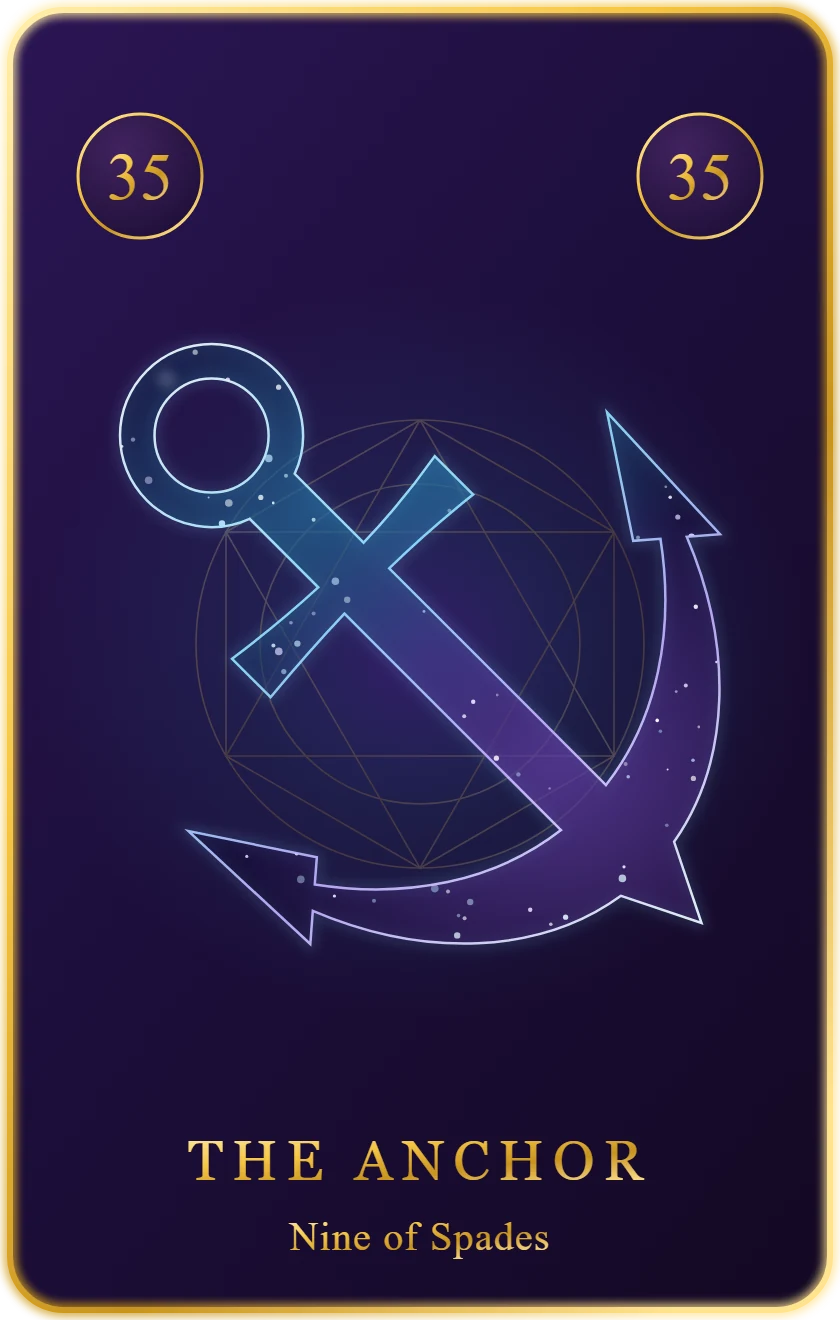
The Anchor carries a word the Lenormand is fond of: to hold. Card 35 names what settles and no longer moves, what resists time and currents. A job that lasts, a bond that does not come undone, a habit taken up, a security acquired.
The Lenormand is literal. The Anchor is not a figure of perseverance to meditate on, it is a word in a sentence, and that word means “it stays”. What it describes is not judged in itself: it states duration, not the quality of what lasts.
A point of history sheds light on the card. In older German decks it first carried the name Hoffnung, hope, before becoming Anker, the anchor. The anchor is a classic attribute of hope in European imagery, which explains the shift. Modern reading has kept the meaning of the object, holding and stillness, rather than that of the original name, but that older layer explains why some readers still hear in it a note of confidence in duration.
On decks of the Dondorf line, around 1890, the card shows an anchor set near a shore, often out of the water. The detail counts: the anchor is not being dropped, it is already there. The movement has taken place, and what the card names is the state that follows.
Two registers share its use. The first is security: a reliable framework, a situation that does not overturn, a point of support. The second is perseverance: holding on, staying in place, carrying on without giving way.
The nuance is essential, and it lies in the very meaning of the object. An anchor prevents drifting, and it also prevents leaving. Depending on the question asked, the Anchor names a solid base or a situation that no longer unties. Nothing on the card says which of the two: that is read on its neighbour, as always. A single card gives a word, not a reading.
On a question of timing, finally, the Anchor leans towards the long: what it touches unfolds over time rather than immediately.
Playing card and traditional reading
The Anchor carries the inset of the Nine of Spades. This correspondence comes from the thirty-six card piquet deck that originally doubled the Petit Lenormand, and it is fixed by the canonical table of the module, never deduced from the name of the card.
In the German school, the Spades suit brings gravity and weight: what is serious, what is not settled with a single gesture. It usefully lights up the Anchor. The stability it names is not light, it has a cost, and it is precisely that cost that makes it solid.
Some modern editions no longer print this inset. The correspondence remains valid for the reading, it is simply absent from the artwork.
Key combinations
The grammar of the Lenormand is fixed: the first card is the noun, the second the qualifier. The Anchor followed by the House speaks of a domestic anchoring, the House followed by the Anchor speaks of a home becoming the fixed point. The two pairs do not say the same thing.
| Combination | Reading |
|---|---|
| The Anchor + The Heart | A lasting love, an attachment that holds |
| The Anchor + The Fox | A stable job, an established career |
| The Anchor + The House | A solid home, a domestic anchoring |
| The Anchor + The Fish | Financial security |
| The Anchor + The Mountain | A stability turning into immobility |
The full mechanics of pairs are set out on the page about reading by combinations.
Position in the Grand Tableau
In a Grand Tableau, each place carries the meaning of the card whose number it holds. Position 35 is the house of the Anchor: what lasts, what you settle on.
The card that lands there indicates where the situation becomes fixed, what the person leans on, or what they do not leave. The Fox in the house of the Anchor points to settled work, the Mountain to an anchoring that has become a blockage.
The table of the thirty-six houses and the three tableau formats are set out on the page about the Grand Tableau.
Keywords
| Register | Words |
|---|---|
| Core meaning | What holds and no longer moves |
| Security | Stability, reliable framework, point of support |
| Effort | Perseverance, tenacity, holding on |
| Reverse side | Immobility, what holds back, what no longer unties |