Meaning
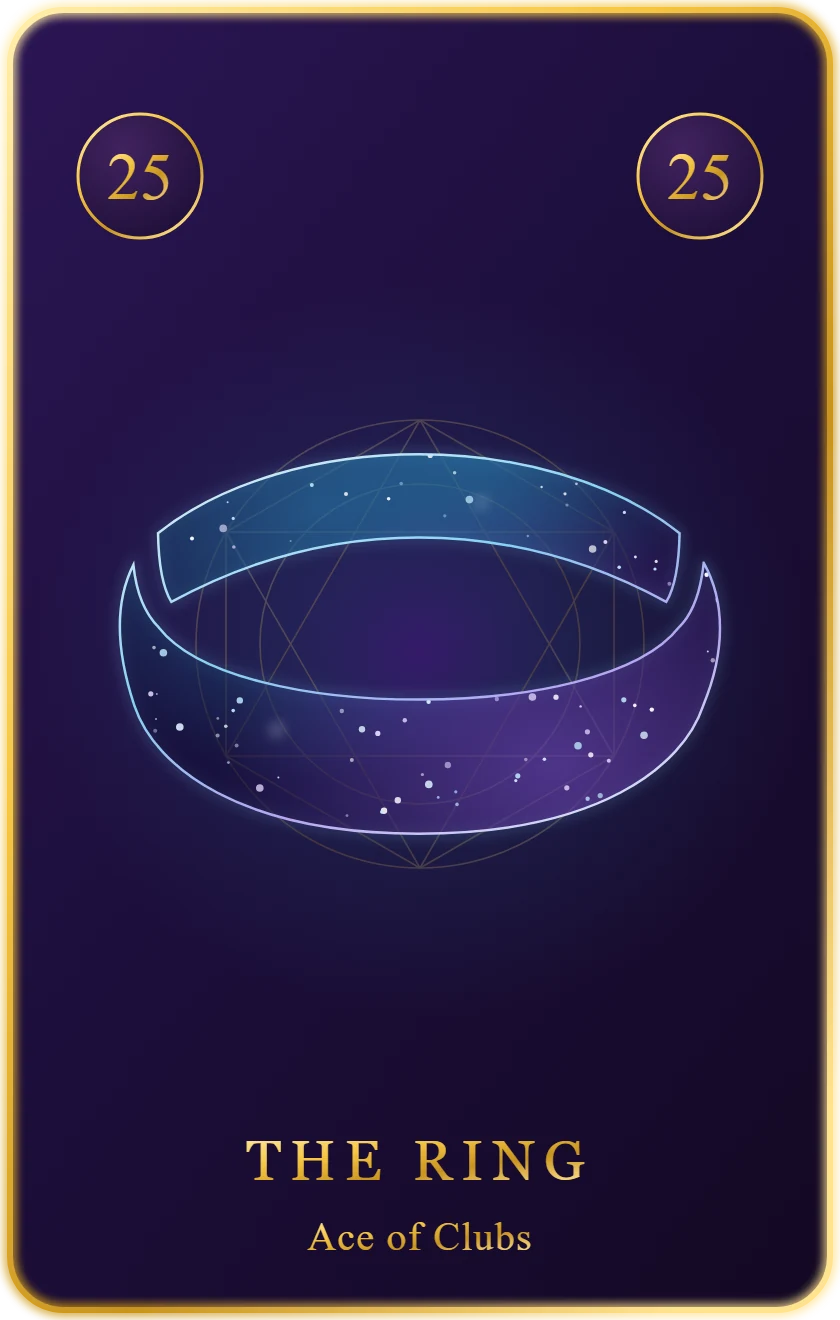
The Ring names what binds and closes on itself. A commitment given, a contract signed, an alliance, a word kept. Card 25 describes the form of the bond, never what is felt inside it: that remains the business of the Heart.
This distinction is the most useful point of the card. A ring can encircle a love, a job, a lease, a partnership, a debt. It does not say whether the bond is a happy one, it says that it exists and that it binds. Many readings lose precision by sliding automatically from the Ring to marriage: marriage is only one of the possible bonds, and it needs a neighbour to be named.
The imagery of the Dondorf line, around 1890, most often shows a set ring, isolated on the picture. The shape counts as much as the object: a circle has neither beginning nor end. From there comes the card’s second register, that of the cycle. What returns each year, what repeats, what loops. A situation starting over identically often carries the Ring nearby.
The third register is closure. A ring also encloses. Depending on the neighbour, card 25 can name a protective framework or a bond that is not easily left. The Mountain beside it hardens the line, the Scythe cuts it, the Snake complicates it.
A note on method: a single card gives one word, not a reading. The Ring in isolation says neither which bond, nor with whom, nor for how long. It supplies the verb “to commit”, and waits for its neighbour to receive a subject.
Finally, the Ring promises nothing. It records that a commitment is at stake in the situation at the time of the spread, or that the question asked bears on a bond to be formalised.
Playing card and traditional reading
The Ring carries the inset of the Ace of Clubs. This correspondence comes from the thirty-six card piquet deck that originally doubled the Petit Lenormand, and it is stable in the Dondorf line.
In the German school, the Clubs suit points to the concrete: work, everyday matters, what gets organised in daily life. That is what prevents reducing the Ring to the emotional register. The rank of Ace reinforces the idea of a beginning and of a foundation: a commitment being laid down, rather than a commitment coming undone.
Some modern editions no longer print this inset and replace it with a verse or with nothing at all. The correspondence remains valid for the reading, it is simply absent from the artwork.
Key combinations
Meaning is born from the pair. The grammar is fixed: the first card is the noun, the second the qualifier. The Ring followed by the Book speaks of a commitment whose terms are written down; the Book followed by the Ring speaks first of a document, which the commitment then qualifies.
| Combination | Reading |
|---|---|
| The Ring + The Heart | An emotional union, a promise of love |
| The Ring + The Fox | A work contract, a professional commitment |
| The Ring + The Scythe | A broken commitment, a cancelled contract |
| The Ring + The Book | A written contract, clauses to be read |
| The Ring + The Snake | A complicated commitment, an ambiguous alliance |
The full mechanics of pairs are set out on the page about reading by combinations.
Position in the Grand Tableau
Position 25 in a Grand Tableau is the house of the Ring: commitment, what binds.
The card that lands there indicates the nature of the bond at stake, or what weighs on it. The Fox in the house of the Ring points to a professional contract, the Mice to a commitment emptying of its substance, the Anchor to a bond that lasts. And when the Ring falls in its own house, the question of commitment is the central subject of the reading.
The three tableau formats and the table of the thirty-six houses are set out on the page about the Grand Tableau.
Keywords
| Register | Words |
|---|---|
| Core meaning | What binds and closes on itself |
| Bond | Commitment, contract, alliance, promise, word given |
| Cycle | Repetition, return, loop, what starts again |
| Closure | Framework, belonging, a bond you do not leave alone |