Meaning
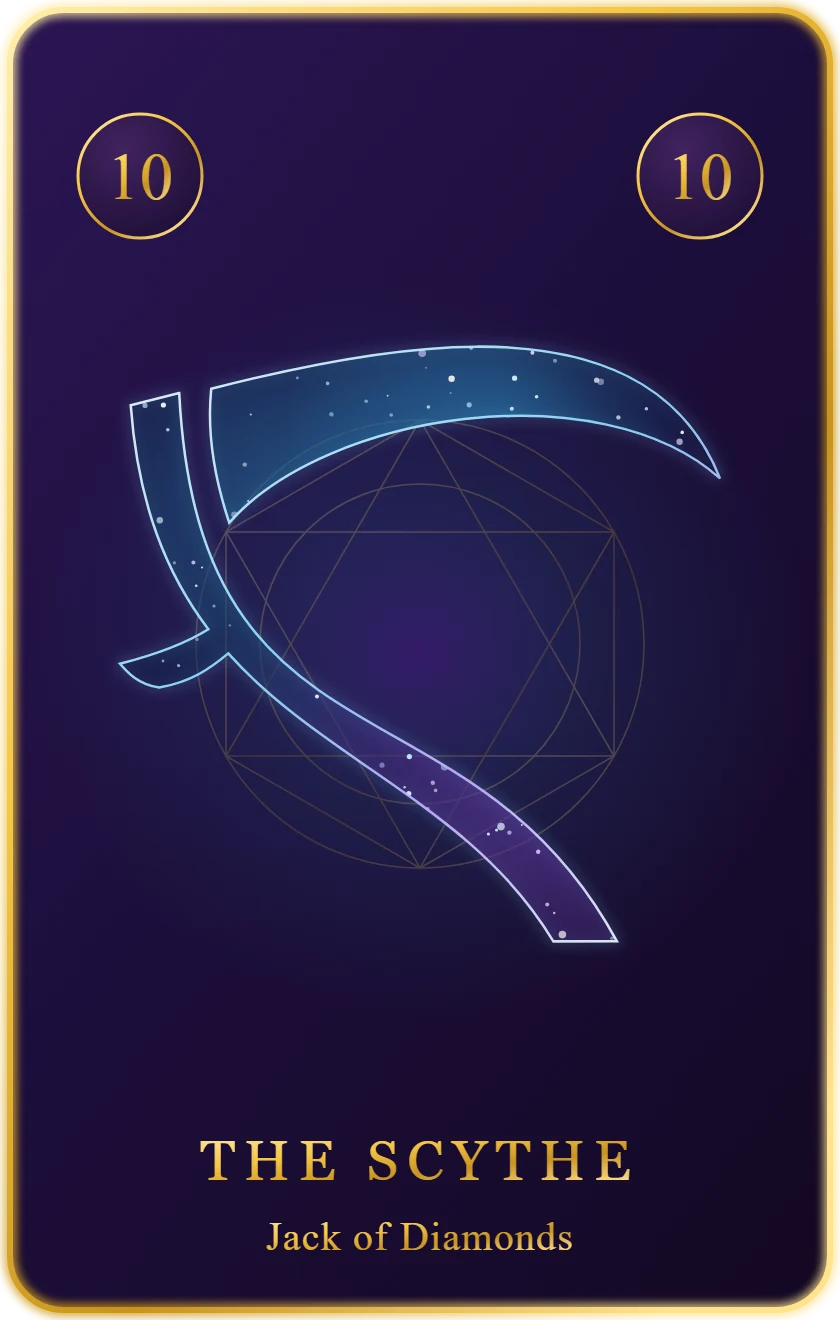
The Scythe is card 10 of the Petit Lenormand, and its word is a gesture: to cut. In one stroke, plainly, without notice and without negotiation. What was continuous stops being so, and the separation between before and after is clean.
On decks of the Dondorf line, around 1890, the tool is shown on its own, often on the diagonal, sometimes with the blade turned towards one specific side of the card. Some schools read that orientation to work out which neighbouring card is affected. It is a refinement that depends on the deck in use and is in no way compulsory.
Two registers coexist in this word, and they are symmetrical. The first is suffered: something stops without having been chosen, a bond breaks, a process is interrupted. The second is active: you cut, you decide, you deliberately put an end to what was dragging on. The Scythe does not distinguish the two by itself. It describes the manner, abrupt, not the intention.
This is worth insisting on, because the card is often badly received: the Scythe is neutral. It judges nothing. A long postponed decision that is finally taken carries exactly the same card as an imposed interruption. What stays constant in both cases is the absence of transition.
Pace, precisely, is part of the meaning. Where other cards describe slow erosion, the Scythe says the opposite: it happens fast, and there was no warning. When a question bears on the tempo of a situation, its presence leans towards the sudden.
A single card gives only a word. The Scythe says there is a cut, never what is cut: the neighbour designates the area, and it is the neighbour that makes the reading possible. Nothing in this card promises an event, it names a manner in which things come apart.
Playing card and traditional reading
The Scythe carries the inset of the Jack of Diamonds. This correspondence comes from the thirty-six card piquet pack that doubled the Petit Lenormand at the outset, and it is fixed by the canonical table, not deduced from the picture.
In the German school, the suit of Diamonds points towards the concrete and towards information: facts that can be observed, things in circulation, material questions. That colours the Scythe: its cut is most often an objective piece of data, something verifiable, rather than an inner feeling.
Some modern editions do not print this inset and replace it with a quatrain or with nothing. The correspondence still holds for the reading, it is simply absent from the artwork.
Essential combinations
The Lenormand is read in pairs, and the grammar is fixed: the first card is the noun, the second the qualifier. The Scythe followed by the Heart and the Heart followed by the Scythe do not say the same thing. In one case the cut bears on the bond. In the other, the bond is what undergoes an abrupt decision.
| Combination | Reading |
|---|---|
| The Scythe + The Heart | An abrupt emotional break |
| The Scythe + The Ring | A contract broken, a commitment cancelled |
| The Scythe + The Fish | A financial cut, a sudden expense |
| The Scythe + The Crossroads | A decision taken between two options |
| The Scythe + The Tree | An intervention on the body, a quick medical act |
On that last line a reservation is in order: a card diagnoses nothing and replaces no medical advice. It names a register, it does not establish a condition. For the full mechanics of pairs, see reading by combinations.
Position in the Grand Tableau
Position 10 of a Grand Tableau is the house of the Scythe: what gets cut, the clean break.
The card that lands there indicates what the cut bears on and where it comes from. The Fox in the house of the Scythe points to an ending that touches work, the Fish to an interruption that can be counted. When the Scythe occupies its own house, its word is reinforced: the separation is plain and not up for discussion.
The table of the thirty-six houses and the three tableau formats are set out on the Grand Tableau page.
Keywords
| Register | Words |
|---|---|
| Core meaning | What cuts in one stroke, without notice |
| Cut | Clean break, separation, interruption, abrupt ending |
| Decision | To cut, to arbitrate, to end, to choose quickly |
| Pace | Suddenness, absence of transition, without warning |