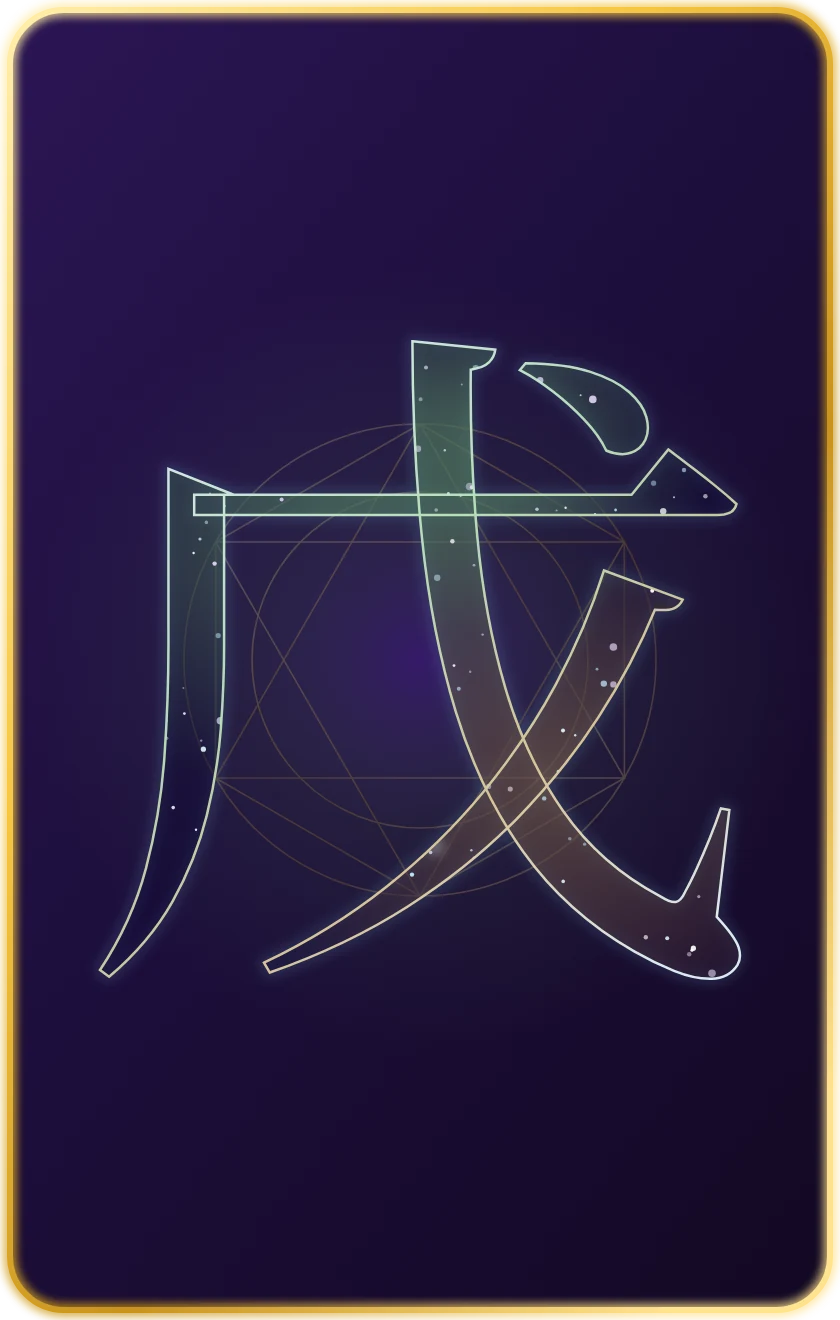
The stem and its image
Wu is the fifth of the ten heavenly stems, Earth in its Yang phase, and its classical image is the mountain.
A point of vocabulary is needed before anything else, because it spares many reading errors: the stem Wu and the branch Wu are two different Chinese characters that pinyin transcription makes identical in writing as well as in speech. The stem Wu is Yang Earth. The branch Wu is that of the Horse. Meeting a Wu in a chart therefore says nothing at all until one has looked at which line it sits on, the line of the stems or the line of the branches.
The image of the mountain carries the whole temperament. A mountain does not move, does not justify itself, does not react to what surrounds it. One goes around it or climbs it, but one does not negotiate with it. It is the massive earth that shelters and stays: whatever settles on its flank finds a support there that will not shift, and that immobility is exactly what one comes looking for.
From there come the stability, the protection and the reliability that this stem carries as its own. A Wu presence holds the frame while others bustle about, and its word counts as a commitment because it does not retract.
The reverse side lies in the same movement. What does not move is slow, and what is firm sometimes ends up stiff. Wu does not change its mind at the pace of events, which is a strength when events are wrong and a handicap when they are right.
Element and polarity
Wu belongs to Earth, one of the five elements of the Wu Xing, and it occupies its Yang phase.
Yang means neither masculine nor superior: it is a state, that of matter extended, exposed, turned outward. Yang Earth is therefore earth in volume, the earth of relief and of mass, not the earth one turns over by hand.
Every element comes in two stems, one Yang and one Yin. The twin of Wu is Ji, Yin Earth, whose image is the garden soil. Both say the same substance in two opposite states: Wu holds it back and raises it, Ji opens it and works it. Confusing the two comes down to confusing a cliff with a vegetable patch on the grounds that both are the same soil.
Where it hides
A stem does not figure only on the visible line of the heavenly stems. It also lodges inside certain earthly branches, in the form of a hidden stem. Wu is one of the best distributed of all the stems: it appears in five branches.
| Branch | Sign | Rank of the hidden stem |
|---|---|---|
| Chen | Dragon | main |
| Xu | Dog | main |
| Si | Snake | secondary |
| Shen | Monkey | secondary |
| Yin | Tiger | third |
The rank indicates the relative weight of the stem inside the branch. In Chen and Xu, Wu is the main hidden stem, which makes these two branches its clearest anchor points. Elsewhere it is present without dominating.
As Day Master
The stem of the day pillar carries a particular name: the Day Master. It is the reference point from which the whole rest of the chart is read. To be born with Wu in that place is therefore to read one’s eight characters from the mountain.
A Wu Day Master observes before moving. Its own way is not to answer fast but to hold position until the situation comes to it, and that patience often passes for slowness among those expecting an immediate reaction. It is in fact the operating mode of mass: it only sets itself in motion for good reasons, and then it no longer stops.
It is also a Day Master people turn towards. Protection with Wu is a reflex rather than a decision: it shelters, it covers, it absorbs the shocks for those standing behind it, without always measuring what that shelter costs it.
The point to watch holds in one word: firmness. It makes the solidity of the person as long as it stays a base, it becomes a wall as soon as it serves as an argument.
Then there is the general rule of BaZi: the Day Master gives the angle of reading, never the whole portrait. A chart is read on eight characters, and Wu is only one of them.
Keywords
- stability
- protection
- reliability
- slowness
- firmness