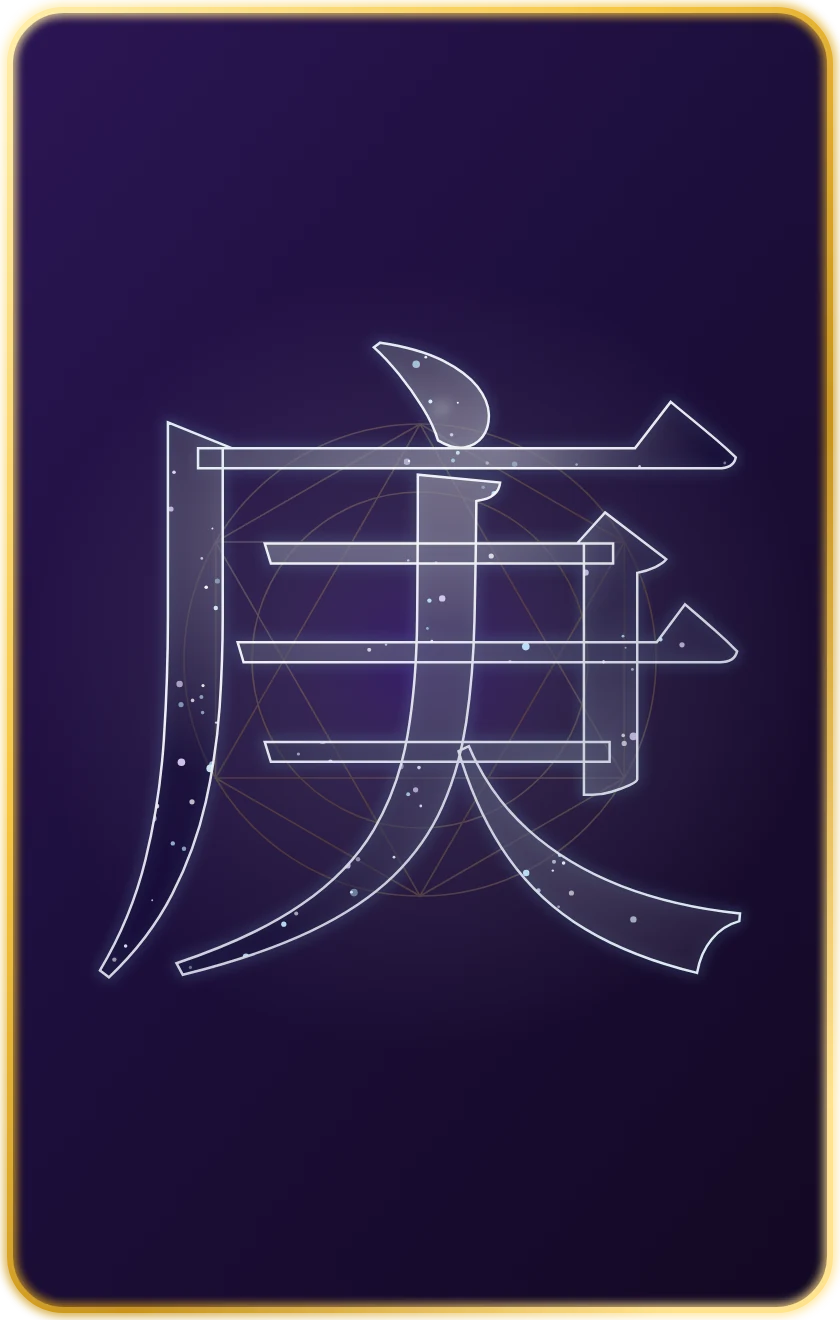
The stem and its image
Geng is the seventh of the ten heavenly stems, Metal in its Yang phase, and its classical image is raw metal, the axe.
The image holds in two words: not worked. This metal does not come out of a workshop, it has been neither polished nor adjusted. Its value comes not from its finish but from its mass and its edge. An axe does not persuade, it separates, and what it has separated does not glue back together.
From there comes the temperament of this stem. Geng decides. Where others weigh the pros and cons at length, it cuts, and it cuts early, because a situation that drags costs it more than a clean mistake. It is the stem of decision in the strict sense: to cut, to cut away, to reduce a question to what can be cut in it.
Justice follows naturally. To separate is also to tell apart what is right from what is not, and Geng puts up badly with arrangements that leave the line blurred. Its courage comes from the same movement: it takes on conflict instead of going around it, including when going around would be more comfortable for everyone.
Its loyalty is made of that same material. It is not tender, it is firm: one knows where one stands with it, and it does not switch sides along the way.
Its hardness is the price of all the rest. An edge knows no nuance, and what has been cut clean has sometimes been cut too fast.
Element and polarity
Geng belongs to Metal, one of the five elements of the Wu Xing, and it occupies its Yang phase.
Yang means neither masculine nor superior: it is a state, that of matter massive, raw, turned outward and towards action. Yang Metal is therefore metal in the block, the metal of the tool and of the weapon, not that of the finished object.
Every element comes in two stems, one Yang and one Yin. The twin of Geng is Xin, Yin Metal, whose image is the jewel, polished metal. The contrast is clear: the value of Geng lies in its edge, that of Xin in its finish. One is made to do, the other to show. Treating them as a single temperament on the grounds that they share an element is the most common error about these two stems.
Where it hides
A stem does not figure only on the visible line of the heavenly stems. It also lodges inside certain earthly branches, in the form of a hidden stem. Geng is present in three of them.
| Branch | Sign | Rank of the hidden stem |
|---|---|---|
| Shen | Monkey | main |
| Chou | Ox | third |
| Si | Snake | third |
The rank indicates the relative weight of the stem inside the branch. Shen is the only plain anchor of Geng: it is the main hidden stem there. In Chou and Si it comes only in third position, present but not in command.
As Day Master
The stem of the day pillar carries a particular name: the Day Master. It is the reference point from which the whole rest of the chart is read. To be born with Geng in that place is to read one’s eight characters from the cutting edge.
A Geng Day Master gets to the point. It asks the questions others avoid, names the problem before the usual precautions, and regularly finds itself in the position of arbiter for that very reason: it is asked to decide because people know it will. That role costs it less than it costs others, it is not looking for general approval.
Its reliability comes from there too. A commitment taken by Geng is a commitment kept, including when it becomes uncomfortable, and those who work with it quickly learn that they can lean on that rigidity as on a support.
The point to watch is the same trait seen from the other side. Raw metal has not yet been given a shape: it cuts without always choosing where. A decision made too fast, a frankness that wounds without need, a demand for justice that leaves no room for circumstance are the errors proper to this stem.
Then there is the general rule of BaZi: the Day Master gives the angle of reading, never the whole portrait. A chart is read on eight characters, and Geng is only one of them.
Keywords
- decision
- justice
- courage
- hardness
- loyalty