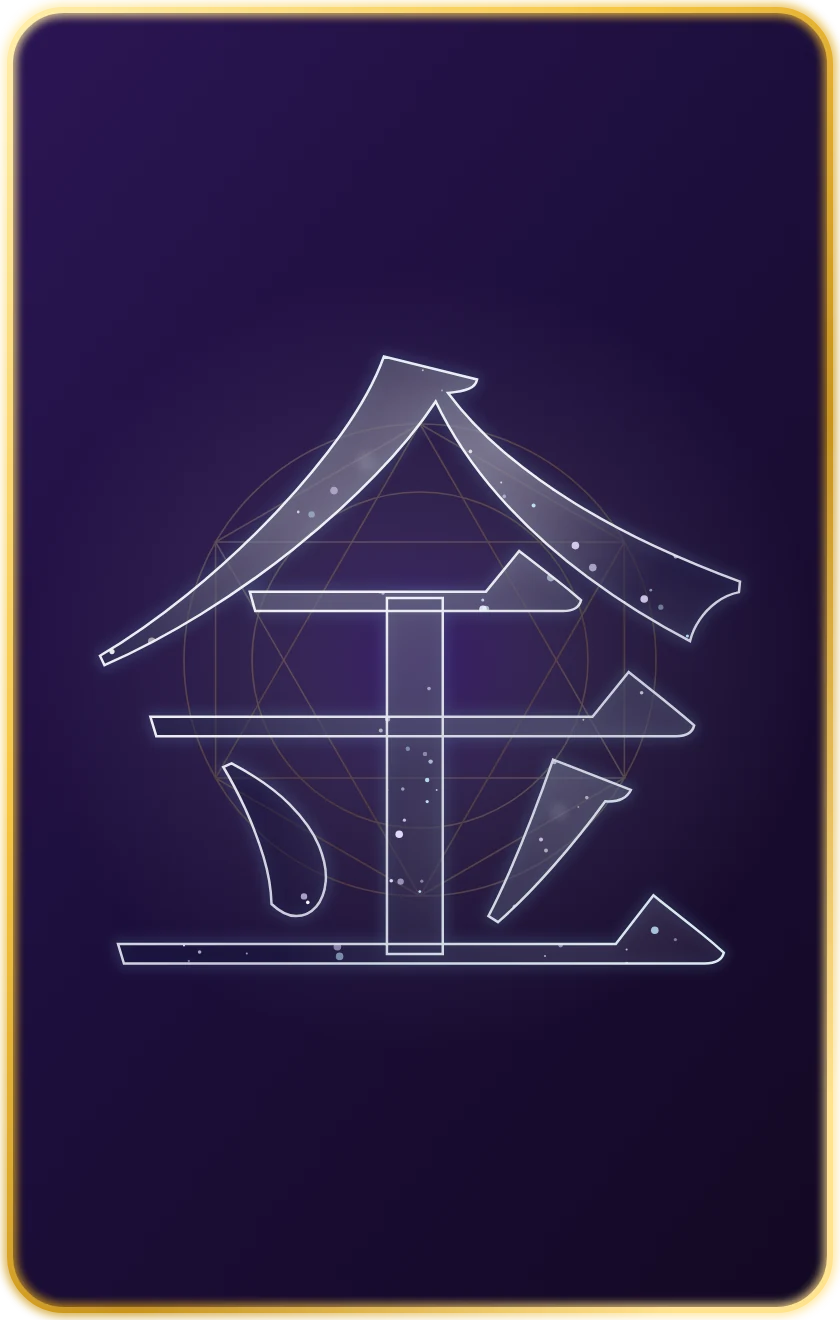
What the element describes
Metal is the fourth of the five movements of the Wu Xing, placed between the Earth that generates it and the Water it produces. Its theme is condensation: what sorts, cuts and keeps only the essential. The word does not name a material but a moment of the cycle, the one where matter stops spreading and tightens around what holds.
Its season is autumn, its direction the West. Autumn makes nothing new: it finishes, it separates, it lets go of what has stopped being useful. That is exactly the gesture of Metal. Where other movements add, this one takes away, and it does so without much visible soul searching.
Its own words come from that function. Rigour first, a demand that negotiates little. Sorting next, its central skill, that capacity to decide what stays and what goes. Justice, which is sorting applied to human affairs, with a taste for the clear rule and the kept word. Structure, which is what remains once the sorting has been done. And sadness, which is the price of it: one never cuts without losing something, and Metal knows that light mourning.
In BaZi, Metal is read neither on its own nor as a label stuck onto a year. It appears through the stems and through the branches, spread across the eight characters of a chart, and it is its proportion in the whole that makes sense.
The two cycles
The first cycle is that of generation. Metal is generated by Earth: the compact is born from the dense, the cutting edge comes from the ground that concentrated it. It generates Water in turn: what has been sorted and tightened ends up liquefying and going back down. Metal therefore receives from Earth and gives to Water. It is neither a beginning nor an end, only a compulsory passage between the two.
The second cycle is that of control, and it should not be heard as a destruction: it is a regulation. Metal controls Wood, which is to say that it bounds its expansion, prunes its growth and gives it a shape. Without that control, Wood spreads without limit; without Wood, Metal has nothing to work on. Metal is itself controlled by Fire, which heats it, softens it and stops it from staying a frozen edge.
These four relations (generated by Earth, generates Water, controls Wood, controlled by Fire) are enough to place Metal in any chart. None is good or bad in itself: each one describes an exchange, and it is their balance that counts.
Its stems and its branches
Metal shows itself through two heavenly stems and two earthly branches. The stems are Geng, of Yang polarity, and Xin, of Yin polarity. The two polarities are not two genders but two phases of one movement: one is its open and deployed version, the other its withdrawn and concentrated version.
The branches are Shen, whose animal is the Monkey, and You, whose animal is the Rooster. When one of them occupies a pillar, Metal is present in the chart by way of the branches, whatever the stems may carry.
These four characters, Geng, Xin, Shen and You, are the visible Metal. They are not all the Metal: the branches also shelter hidden stems, and Geng sits inside the Ox as well as inside the Snake, where nothing announces it on the surface. A chart without a single one of those four characters can therefore contain Metal.
When it dominates, when it is missing
A chart where Metal dominates sorts a great deal. The criteria there are clear, the commitments precise, the given word makes law, and the whole stands up. The reverse side is read in the very words of the movement: rigour turns cutting, sorting starts removing what could have stayed, and sadness settles in as a permanent background. It is a Metal that nothing tempers, for lack of Fire to soften it or Wood to shape.
A chart where Metal is missing keeps, on the contrary, what should be let go. Nothing quite ends, matters pile up without a hierarchy, the structure stays vague and the rule gets renegotiated endlessly.
In both cases, nothing is concluded from a single character. One looks at the proportion of Metal among the eight, at the movement that generates it and at the one that regulates it, before saying anything at all about a temperament.
Keywords
- rigour
- sorting
- justice
- sadness
- structure