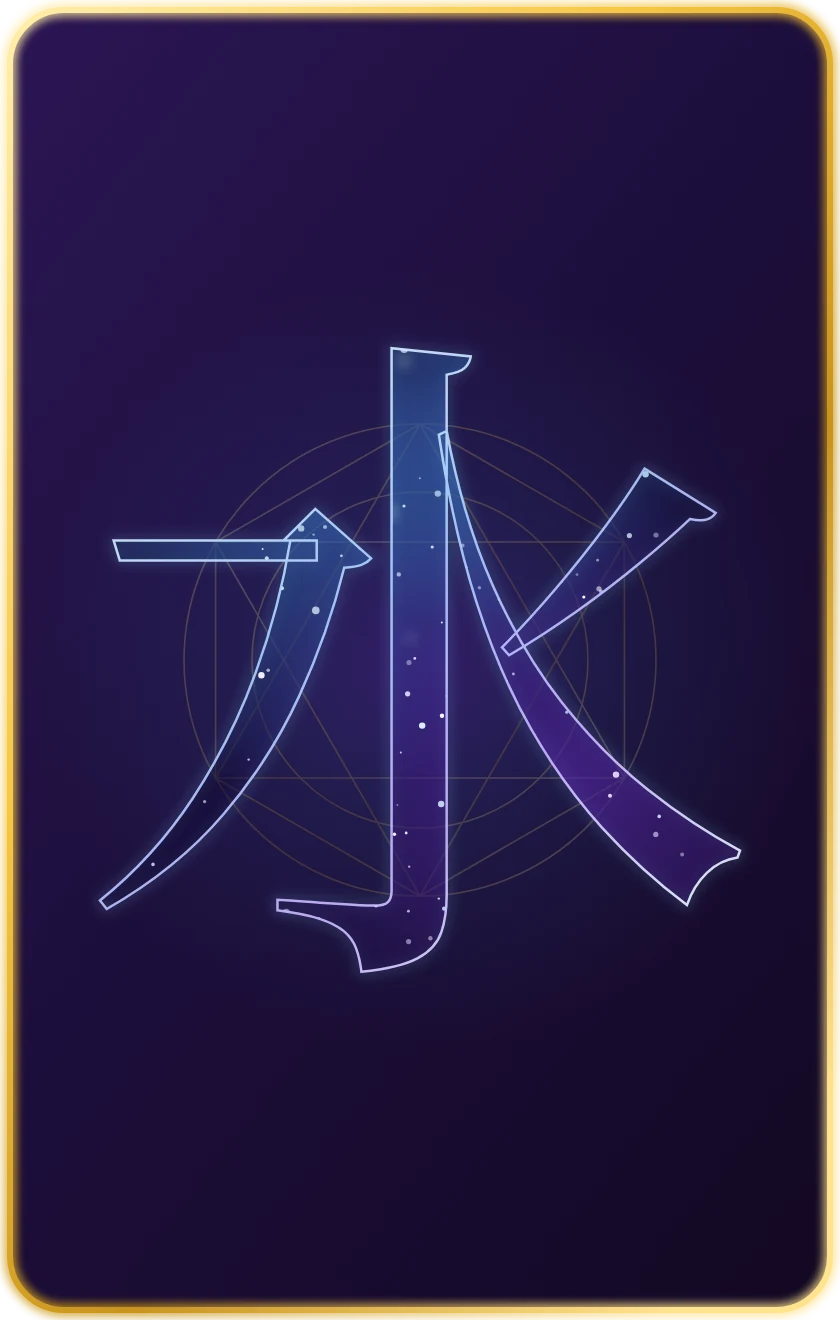
What the element describes
The Water in question here is one of the five movements of the Wu Xing, and not the Water element of Western astrology: the two systems use the same word without describing the same thing. Chinese Water is the fifth movement, the one that receives from Metal and gives back to Wood, and it is read through heavenly stems and earthly branches.
Its theme is conservation: what goes down, keeps the reserve and waits for its hour. Its season is winter, its direction the North. Winter produces nothing visible, and that is exactly its work: it sets aside, it slows down, it keeps intact the capacity to start again. Water does not rise, it goes down, it looks for the low point and stays there.
Its own words come from that function. Depth first, what does not show itself on the surface. Reserve next, in both senses of the word: restraint in behaviour and a stock one does not touch. Intuition, which is knowledge coming back up without having been reasoned. Will, which is not strength here but tenacity, the patience of water that ends up getting through anywhere. And fear, the natural reverse side of the movement: whoever keeps a reserve anticipates a shortage.
In BaZi, Water is not assigned to a year like a label. It appears through the stems and through the branches, spread across the eight characters of a chart, and it is its proportion in the whole that makes sense.
The two cycles
The first cycle is that of generation. Water is generated by Metal: what has been sorted and tightened liquefies and goes back down. It generates Wood in turn, since nothing grows without a prior reserve. Water is therefore at once the end point of a condensation and the starting point of a growth: it loops the cycle without closing it.
The second cycle is that of control, and it is not a destruction but a regulation. Water controls Fire: it tempers its rise, it bounds the radiance so that it does not scatter. It is itself controlled by Earth, which dams it, gives it a bed and stops it from dissolving everything. Water without a bank keeps nothing any more, it simply spreads.
These four relations (generated by Metal, generates Wood, controls Fire, controlled by Earth) are enough to place Water in any chart. None is good or bad in itself: each one describes an exchange, and it is their balance that is read.
Its stems and its branches
Water shows itself through two heavenly stems and two earthly branches. The stems are Ren, of Yang polarity, and Gui, of Yin polarity. The two polarities are not two genders but two phases of one movement: one is its wide and mobile version, the other its fine and seeping version.
The branches are Zi, whose animal is the Rat, and Hai, whose animal is the Pig. When one of them occupies a pillar, Water is present in the chart by way of the branches, whatever the stems may carry.
These four characters, Ren, Gui, Zi and Hai, are the visible Water. They are not all the Water: the branches also shelter hidden stems, Ren sits inside the Dragon as well as inside the Monkey, and Gui inside the Ox, where nothing announces them on the surface. A chart without a single one of those four characters can therefore contain Water.
When it dominates, when it is missing
A chart where Water dominates keeps a great deal. There is depth, available resource, a capacity to wait for the right moment rather than force a way through, and an intuition that often falls right. The reverse side is read in the very words of the movement: reserve turns into withdrawal, waiting drags past the hour, fear takes over from will and nothing comes back up to the surface. It is a Water that nothing dams, for lack of Earth to give it a bed.
A chart where Water is missing, on the contrary, does not keep anything. Everything is spent as it comes, there is no depth to draw from when the effort lasts, and Fire no longer finds a counterweight there.
In both cases, nothing is concluded from a single character. One looks at the proportion of Water among the eight, at the movement that generates it and at the one that regulates it, before saying anything at all about a temperament.
Keywords
- depth
- reserve
- intuition
- fear
- will