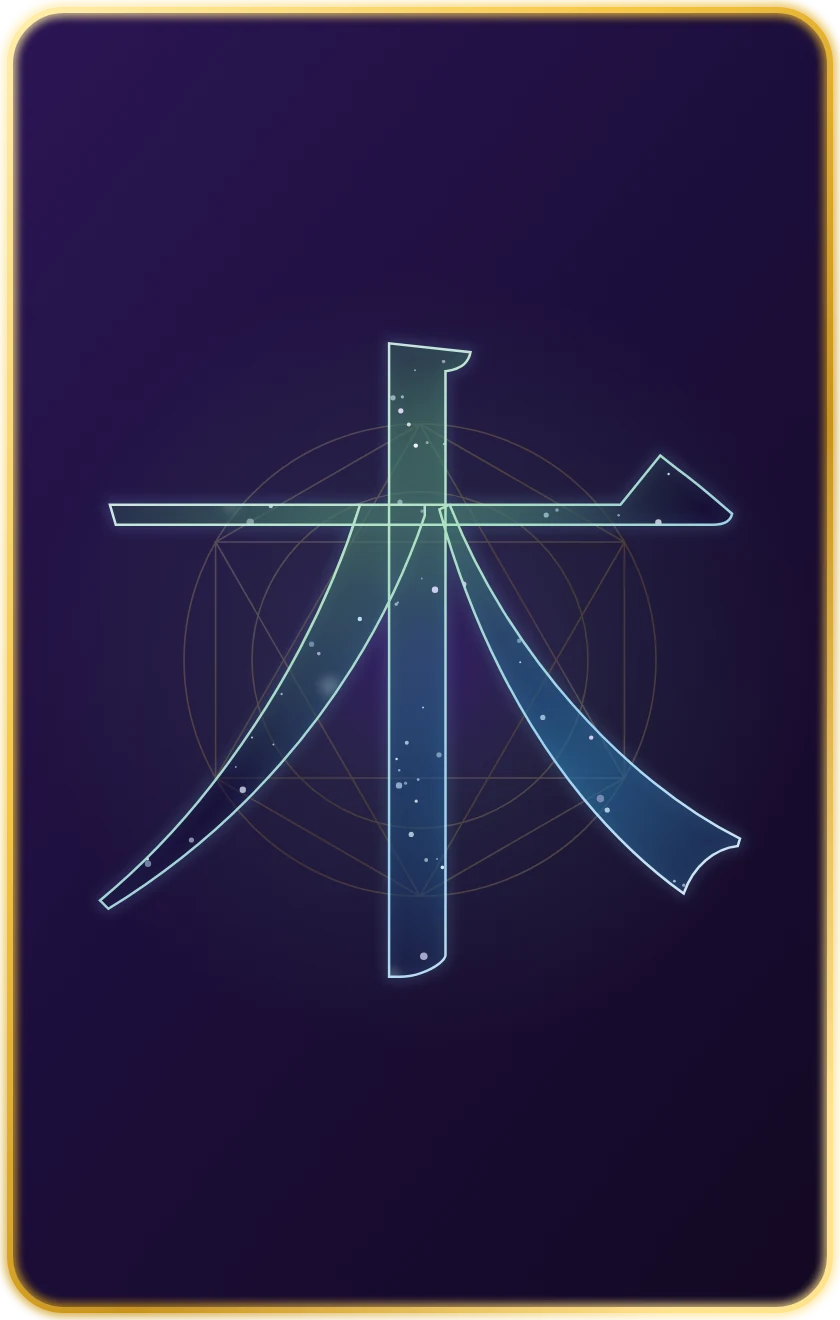
What the element describes
Wood is not a material, it is a movement. What the word names in the Chinese Wu Xing is expansion: what grows, reaches for the light and takes up space. A seed coming up does not negotiate its way through, it pushes aside whatever stands in the way. The whole reading of Wood is held in that one gesture.
Its season is spring, its direction the East. These two markers are not decorative: they name the moment of the cycle where energy comes out of storage and sets off, and the point on the horizon where the morning light comes from. Wood is a beginning, never a conclusion.
What it brings to a chart belongs to the order of momentum. Where Wood is present there is a project, a direction, the wish to move towards something that does not exist yet. Vision is part of its own substance: Wood sees far, sometimes further than it can actually reach.
Its reverse side has a precise name, anger. Growth that is prevented does not disappear, it turns back on itself. Thwarted Wood pushes anyway, against the obstacle, and out of that blocked push comes irritation. It is not a flaw of character, it is the same energy with nowhere to go.
One element does not make a chart. The eight characters of a BaZi mix several elements, and it is their balance of power that counts, never one element on its own.
The two cycles
The five elements are not five separate boxes. They are caught in two circuits that link them all, and it is the place of Wood inside those circuits that gives it its concrete reading.
The first is the generating cycle. Wood is generated by Water, which keeps the reserve: without a reserve, nothing grows. It generates Fire in turn, since it is what feeds the flame. In a chart this means that Water feeds Wood and that Wood spends itself for Fire. An element that generates gives something away, it does not keep it.
The second is the controlling cycle. Wood controls Earth: the root pierces the ground, settles in and works it. Wood is itself controlled by Metal, which prunes it and stops the growth.
Controlling is not destroying. The controlling cycle is a regulation: it stops one element from taking up all the room. Wood without Metal grows shapeless and heads off in every direction; Wood crushed under Metal stops growing at all. In front of a chart, the useful question is therefore never which element is the strongest, but what holds what.
Its stems and its branches
Every element appears in a chart under two forms: the heavenly stems, which express it directly, and the earthly branches, which carry it under the name of an animal.
Wood has two stems. Jia is Yang Wood, Yi is Yin Wood. These are two regimes of the same movement, not two different forces: the same expansion, once upright and once supple.
It has two branches. The branch Yin is the Tiger, the branch Mao is the Rabbit. Mind the name of the first one: the branch Yin is written with a Chinese character that has nothing in common with the Yin phase. Two distinct words, one single romanisation, and no deduction possible from one to the other.
A chart can therefore carry a great deal of Wood without any year animal announcing it. The share of Wood is counted over the eight characters, not over the birth sign.
When it dominates, when it is missing
A chart where Wood dominates moves forward. Projects follow one another, the direction is clear, the wish often comes before the means. The risk is not a lack of momentum but its excess: too many things started, too few finished, and an irritation that rises as soon as the movement is slowed. Abundant Wood gains from finding Metal to prune it and Fire to spend what it produces.
A chart where Wood is missing holds a course poorly. Starting costs something, the vision runs short, one would rather rearrange what already exists than open something new. It is not an inability: it is momentum that has to come from elsewhere, from the Water that feeds it or from a setting that calls for it.
These two portraits are tendencies, not verdicts. No element is good or bad in itself, and the same Wood reads differently according to what surrounds it in the eight characters.
Keywords
- growth
- momentum
- project
- anger
- vision