Meaning
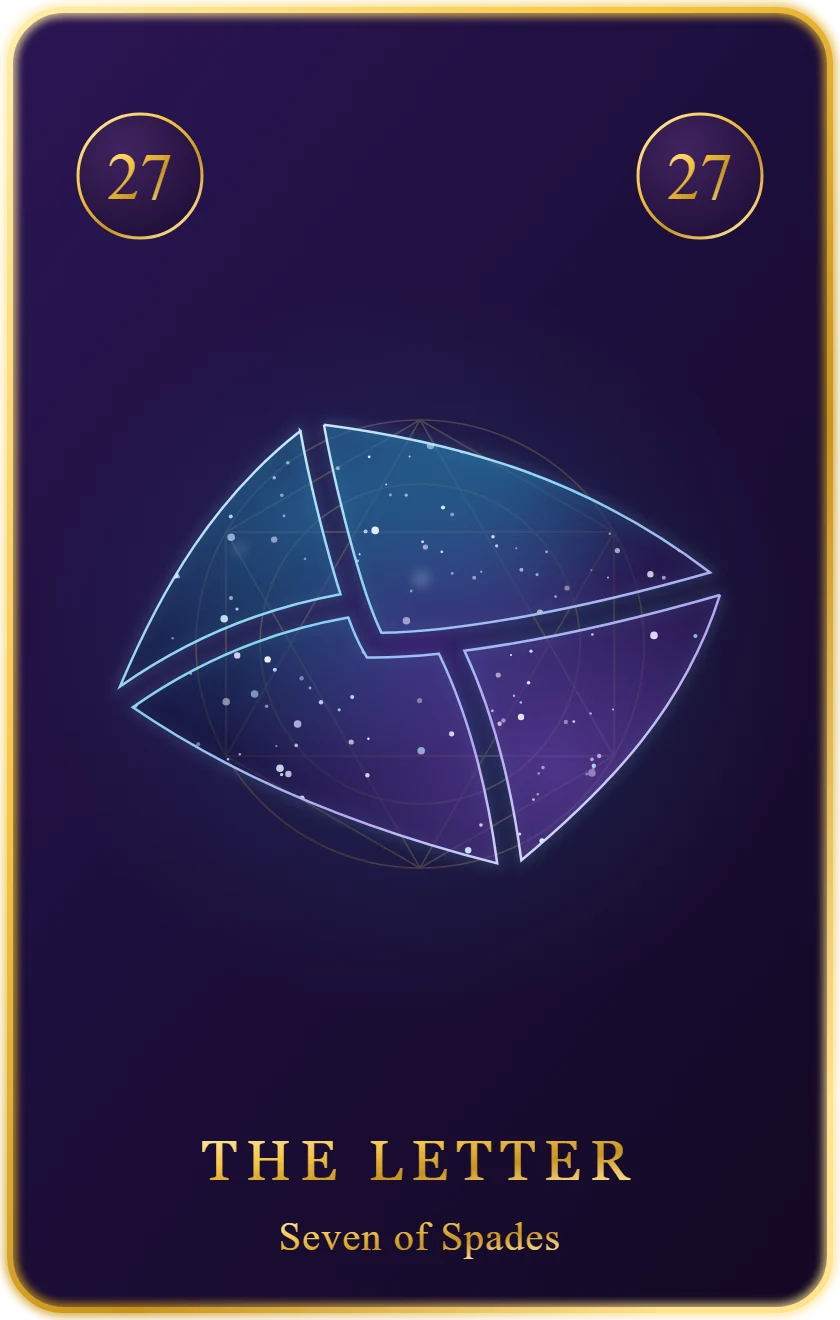
The Letter names what circulates in writing. A letter, an email, a contract sent out, a form, a posted message. Card 27 designates the medium and its movement, not the content of the text.
It is a card of communication, but of communication that leaves a trace. Where the Birds speak of conversation and of words exchanged out loud, the Letter speaks of what is written down and kept. Speech is forgotten, writing is read again. This distinction is useful in questions of work and administration, where the form of the message counts as much as what it says.
Not to be confused with News in the Oracle de Belline: the two cards both speak of a message but do not share a name or a reading. In Belline, News announces a message, a piece of information, or a decisive contact, read in a more symbolic register. In the Petit Lenormand the Letter stays literal: it names the written item as an object, and says nothing about its weight until a neighbour has qualified it.
The imagery of the Dondorf line, around 1890, shows a sealed envelope or a folded sheet, alone on the picture. The fold stays closed, which is consistent with the word. The card states that a written item is there, it does not open it.
Three uses come up most often. Correspondence in the strict sense, paper or digital. The formal document: contract, certificate, summons, invoice. And the written trace within a relationship: a message that declares, a reply that is missing, a text read over twenty times.
A point of method: a single card gives one word, not a reading. The Letter in isolation says neither who the written item comes from nor whether it is favourable. It supplies the medium, the neighbour supplies the tone. Finally, the card announces nothing: it names a written item present in the situation or in circulation at the time of the spread.
Playing card and traditional reading
The Letter carries the inset of the Seven of Spades. This correspondence comes from the thirty-six card piquet deck that originally doubled the Petit Lenormand, and it is stable in the Dondorf line.
In the German school, the Spades suit gives weight and seriousness: what settles matters, what binds, what comes from an authority. Applied to the Letter, it leans towards formal mail rather than towards the affectionate note. The low rank tempers the reading: an ordinary document, not a major act.
Some modern editions no longer print this inset and replace it with a verse or with nothing at all. The correspondence remains valid for the reading, it is simply absent from the artwork.
Key combinations
Meaning is born from the pair. The grammar is fixed: the first card is the noun, the second the qualifier. The Letter followed by the Fox speaks of a work document; the Fox followed by the Letter speaks first of the trade, which the written item then specifies. These are not the same sentences.
| Combination | Reading |
|---|---|
| The Letter + The Rider | Mail on its way, a reply arriving |
| The Letter + The Heart | An affectionate message, a note that declares |
| The Letter + The Fox | A professional document, work correspondence |
| The Letter + The Tower | Administrative mail, an official act |
| The Letter + The Clouds | A misunderstood message, an ambiguous written item |
The full mechanics of pairs are set out on the page about reading by combinations.
Position in the Grand Tableau
Position 27 in a Grand Tableau is the house of the Letter: what is written, the message that circulates.
The card that lands there indicates the area the written item belongs to. The Tower in the house of the Letter points to official mail, the Heart to a personal note, the Clouds to a message that leaves a doubt. And when the Letter falls in its own house, the reading narrows onto written communication itself.
The three tableau formats and the table of the thirty-six houses are set out on the page about the Grand Tableau.
Keywords
| Register | Words |
|---|---|
| Core meaning | What circulates in writing |
| Medium | Mail, email, message, form, dispatch |
| Formal | Document, contract, certificate, deed, written record |
| Trace | What is kept, what is read again, what binds |