Meaning
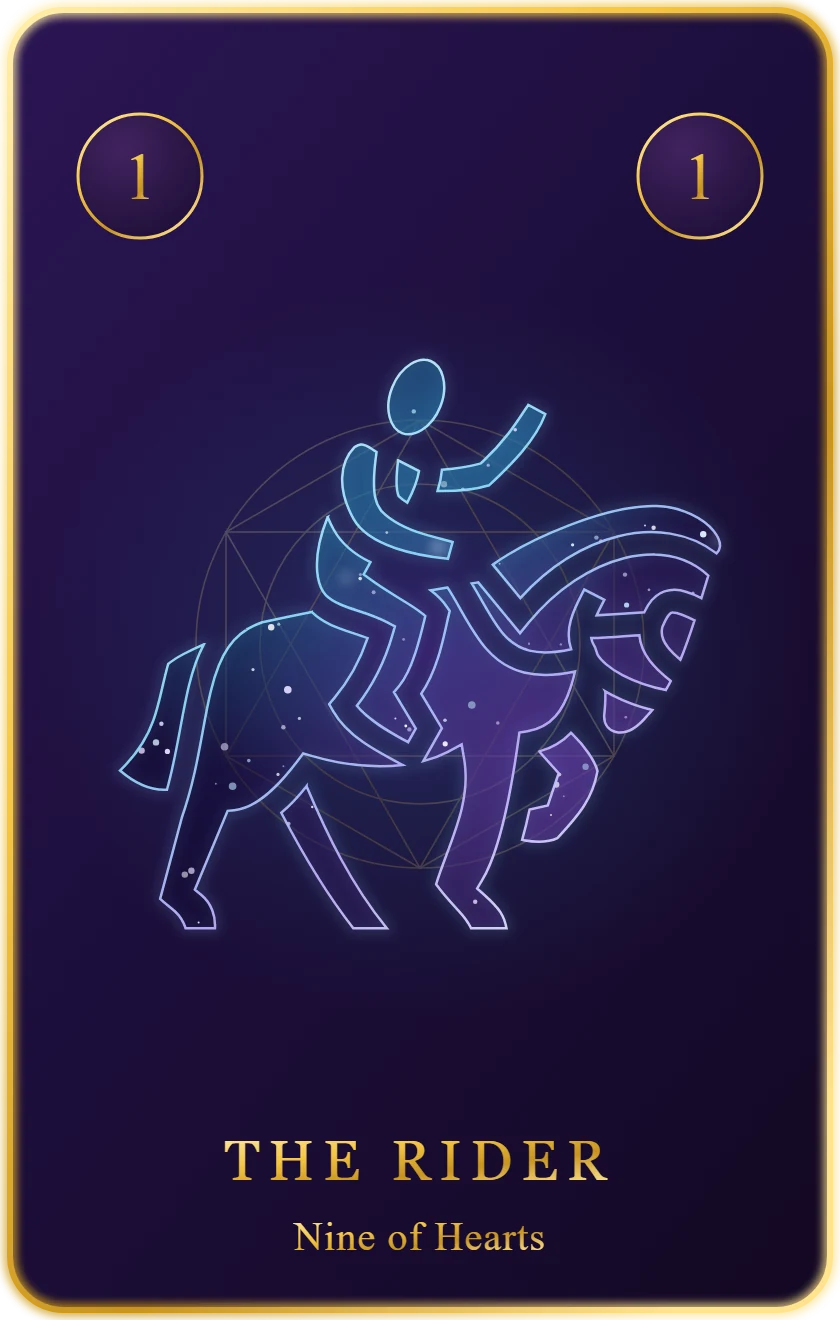
The Rider is card 1 of the Petit Lenormand, and its word is about as plain as it gets: something is arriving. No promise, no dated event, just a movement that comes from outside and heads your way.
This is exactly where the Lenormand parts company with tarot. The Rider is not a figure to contemplate, nor an image of the traveller. It is a word in a sentence, and that word means to arrive, to approach, to bring. It tells you that movement is in play, not what that movement carries.
On decks of the Dondorf line, around 1890, the card shows a rider at full gallop, usually facing right, which in the usual reading convention means towards the future. Speed is part of the meaning: the Rider names a short movement, not a slow process. When you want to know how long a situation will take, its presence leans towards the brief.
In a reading it almost always takes one of two roles. Either it points to a piece of news, a message, information in circulation. Or it points to a person moving towards you: a visit, a messenger, a go-between. The neighbouring card settles which of the two, and it supplies the content.
A note on method: the Rider never says whether what arrives is good or bad. It is neutral by construction. Next to the Clouds it brings something murky. Next to the Sun, something clear. The verdict always comes from the neighbour, never from the Rider itself.
Playing card and traditional reading
The Rider carries the inset of the Nine of Hearts. This correspondence comes from the original structure of the deck, which doubled every card with a card from the thirty-six card piquet pack.
In the German school, the suit of Hearts turns the card towards the emotional and relational register. A Rider under this suit speaks more readily of news that touches you, of a bond, of someone close, than of an administrative notice. It is a nuance, not an absolute rule: the context of the question stays in charge.
Some modern editions, in particular contemporary artist decks and the Red Owl, no longer print this inset and replace it with a quatrain or with nothing at all. The correspondence still holds for the reading, it is simply absent from the card face.
Essential combinations
The Lenormand is read in pairs, and the grammar is fixed: the first card is the noun, the second is the qualifier. The Rider followed by the Letter and the Letter followed by the Rider do not say the same thing. In the first case, what arrives is a written document. In the second, the written document concerns a journey.
| Combination | Reading |
|---|---|
| The Rider + The Letter | Mail on its way, a written answer drawing closer |
| The Rider + The Heart | News in matters of the heart, a rapprochement declaring itself |
| The Rider + The House | A visit, someone coming right into the home |
| The Rider + The Crossroads | Several pieces of news arrive at once, a choice presents itself |
| The Rider + The Fox | Work news, or information that needs checking |
To go further into the mechanics of pairs, see reading by combinations.
Position in the Grand Tableau
In a Grand Tableau, each position carries the meaning of the card whose number it holds. Position 1 is therefore the house of the Rider: what arrives, the expected news, what gets under way.
The card that lands there indicates the area the movement comes from. The Fish in the house of the Rider point to news about money, the Tree to news about health. And when the Rider falls in its own house, its word is intensified: the movement is clean and quick.
The full method, including the three tableau formats and the table of the thirty-six houses, is set out on the Grand Tableau page.
Keywords
| Register | Words |
|---|---|
| Core meaning | What comes from outside and sets things in motion |
| Movement | News, message, arrival, approach, speed |
| Person | Visitor, messenger, go-between, the one who comes |
| Pace | Short term, imminent, brief |