Meaning
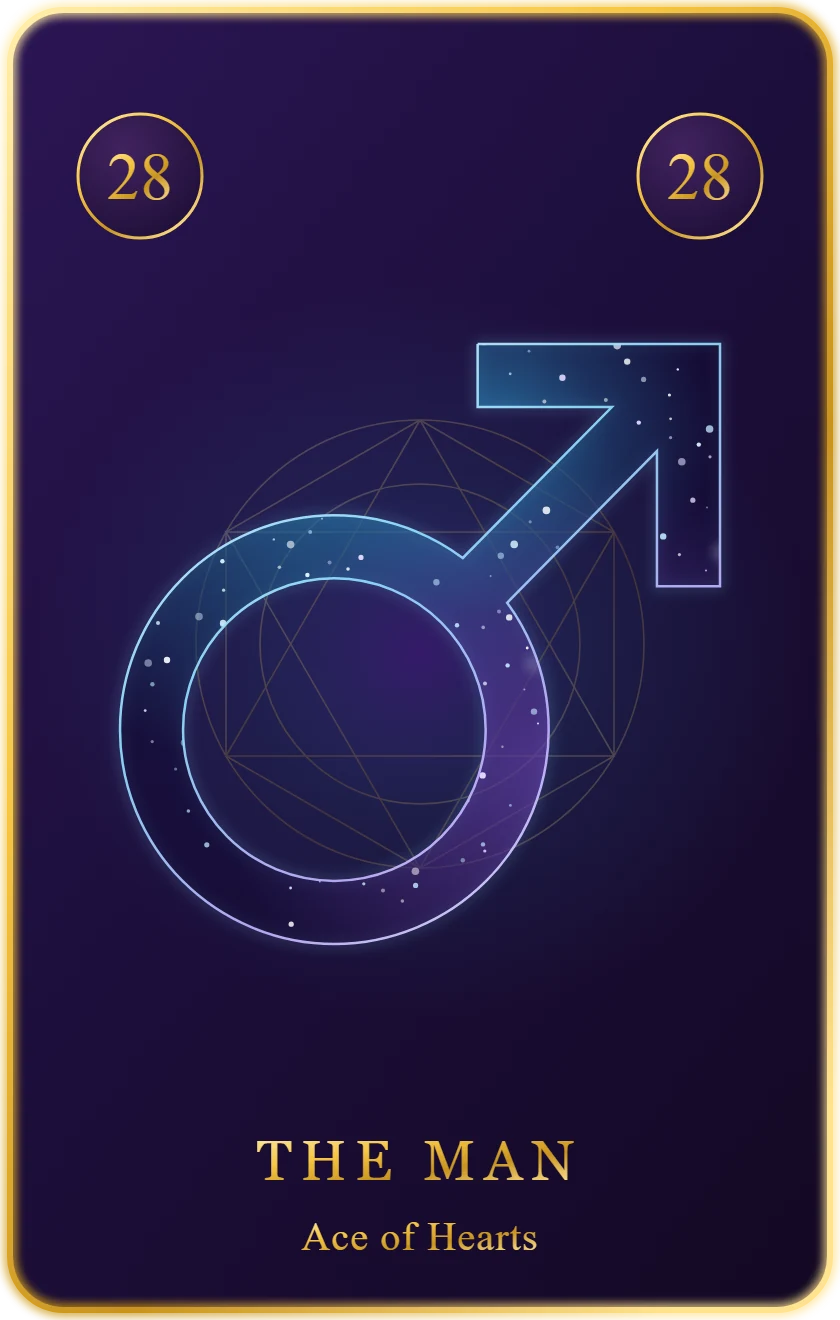
The Man is structurally different from the other thirty-four cards of the deck. Those carry a word: to arrive, to wear out, to bind, to write. Card 28 carries a person. This is what is called a significator.
In practice it designates the querent when the querent is a man, or the central male figure of the question when the person drawing is not concerned themselves: the partner, the father, the business associate, the manager. It does not describe a character, it occupies a place. That is why it is almost impossible to read on its own: a significator in isolation says “someone”, without saying anything more.
One point of numbering deserves stating plainly, because it is a recurring source of error. The Man is card 28 and The Woman is card 29, in that order, in the German school of the Dondorf line that this module follows. Several widespread English language sources swap the two numbers. If a table you consult places the male significator at 29, it does not match the reference used here.
The imagery of the Dondorf line, around 1890, shows the figure full length, often in profile, turned towards one side of the card. That orientation counts in some schools: what the figure looks at would belong to where he is going, what he leaves behind to what he is leaving. The convention varies from deck to deck, so it is better to check your own copy before making it a rule.
A useful distinction: card 28 and the Woman are the two main significators of the deck, and they answer each other. Placed side by side, they name the relationship between the two people rather than each of them.
Other person cards exist and serve as secondary significators when the question involves several figures: the Child (13) for a young person or a newcomer, the Dog (18) for a loyal friend, the Fox (14) for a professional figure or for someone whose intentions call for checking, the Bear (15) for an authority or an elder, the Snake (7) for a person who complicates matters, the Stork (17) for the one who brings a change, the Lily (30) for an elder or a figure of experience. These cards keep their usual word: they become people only if the question explicitly calls for it.
Finally, the Man announces nothing. It promises neither a meeting nor a return. It names a place occupied in the situation at the time of the spread, and that is already the pivot of the whole reading.
Playing card and traditional reading
The Man carries the inset of the Ace of Hearts. This correspondence comes from the thirty-six card piquet deck that originally doubled the Petit Lenormand, and it is stable in the Dondorf line.
In the German school, the Hearts suit points to the emotional and relational register. On a significator, that suit has a consequence for the reading: it is a reminder that the figure exists first through his bonds, and that his position is always read in relation to the other cards, never in a vacuum. The rank of Ace adds the idea of a foundation and a starting point.
Some modern editions no longer print this inset and replace it with a verse or with nothing at all. The correspondence remains valid for the reading, it is simply absent from the artwork.
Key combinations
Meaning is born from the pair. The grammar is fixed: the first card is the noun, the second the qualifier. With a significator the rule reads simply: the card that follows the Man describes what characterises him or what occupies him.
| Combination | Reading |
|---|---|
| The Man + The Heart | A man in love, a feeling carried by him |
| The Man + The Woman | The couple, the relationship between the two significators |
| The Man + The Fox | A man in his trade, his working life |
| The Man + The Crossroads | A man facing a choice |
| The Man + The Anchor | A stable man, settled in his situation |
The full mechanics of pairs are set out on the page about reading by combinations.
Position in the Grand Tableau
Position 28 in a Grand Tableau is the house of the Man: the place of the male figure. But card 28 mostly plays another role there, that of the anchor point of the whole reading.
You locate it first, then read the tableau from it. The cards behind it belong to what came before, those in front to what follows, those above to what dominates the situation, those below to what carries it. Distance does the rest: the closer a card sits to the significator, the more it weighs and the more current it is; the further away it is, the weaker or more remote its influence in the sequence.
The three tableau formats, the reading of distances and the table of the thirty-six houses are set out on the page about the Grand Tableau.
Keywords
| Register | Words |
|---|---|
| Core meaning | Significator: the one around whom the reading is organised |
| Role | The male querent, the central male figure |
| Reading function | Anchor point, position marker, measure of distances |
| Secondary significators | Child, Dog, Fox, Bear, Snake, Stork, Lily |