Meaning
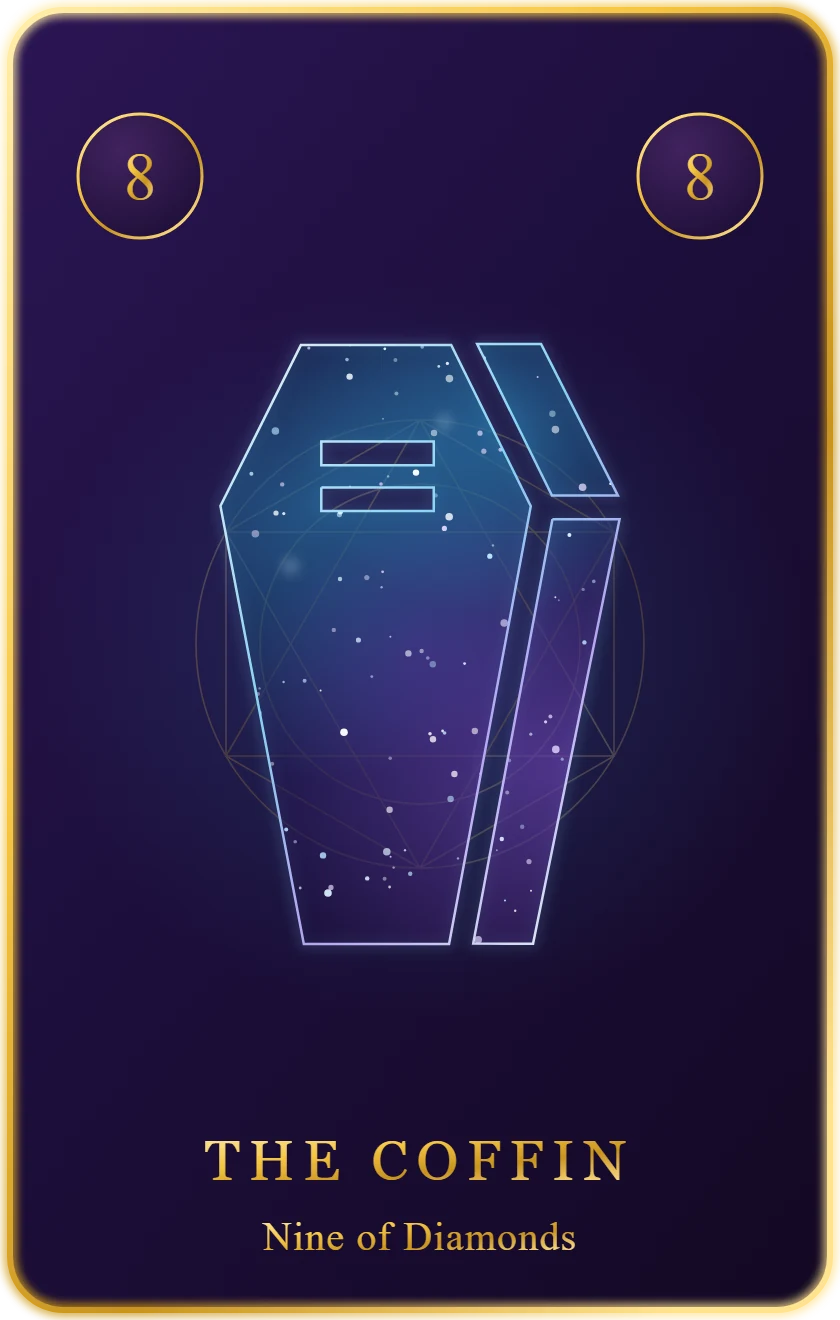
The Coffin is card 8 of the Petit Lenormand, and its word is the ending.
The heaviest literal reading has to be set aside first. In ordinary Lenormand practice, the Coffin is not read as an announcement of death, and a card reading is not practised in that register. What the card names is what comes to an end: a contract that stops, a phase that closes, a habit that ceases, a situation that has run its course.
The exact word would be closure. Something has reached its end, and what follows is not a continuation. That is what separates the Coffin from the cards of blockage. The Mountain prevents progress, the Mice wear things down slowly. The Coffin slows nothing: it observes that what existed no longer exists in that form.
Two practical consequences follow. The first is that it carries a share of rest: what is finished no longer asks for energy. The second is that it opens, by necessity, an empty space. That is why the German tradition readily associates it with transformation. The ending is not the subject, it is the condition of what comes next, and the neighbouring card says what that space becomes.
On decks of the Dondorf line, around 1890, the card shows a closed coffin, set down, with no figures around it. The absence of a scene speaks: there is no procession and no pictured grief, only a closed object. The Lenormand is literal, and here literalness denotes a state, not a drama.
A single card gives only a word, never a reading. The Coffin does not say what is ending, and it does not say whether that is desirable either. Its neighbours specify the area, and the context of the question stays in charge.
Playing card and traditional reading
The Coffin carries the inset of the Nine of Diamonds. This correspondence comes from the thirty-six card piquet pack that doubled the Petit Lenormand at the outset.
In the German school, the suit of Diamonds refers to the concrete, the everyday and what can be counted. It turns the endings the Coffin names towards the factual rather than the emotional: an activity that stops, a commitment that expires, a spending that ceases. That does not exclude the ending of bonds, but the card treats them as facts, not as emotions.
Some modern editions do not print this inset and replace it with a quatrain or with full artwork. The correspondence still holds for the reading, it is simply absent from the card face.
Essential combinations
The Lenormand is read in pairs, and the grammar is fixed: the first card is the noun, the second is the qualifier. The Coffin followed by the Bouquet describes an ending followed by a renewal. The Bouquet followed by the Coffin describes a pleasant moment coming to an end, which is not the same sentence.
| Combination | Reading |
|---|---|
| The Coffin + The Heart | The end of an attachment, a feeling going out |
| The Coffin + The Fox | The end of a job, a post coming to an end |
| The Coffin + The Bouquet | An ending followed by a renewal, a grief that flowers again |
| The Coffin + The Tree | A convalescence, a body going through a transformation |
| The Coffin + The Key | A necessary ending that unlocks what comes next |
The full mechanics of pairs are set out in reading by combinations.
Position in the Grand Tableau
Position 8 of a Grand Tableau is the house of the Coffin: what is ending, what has to be left behind.
The card that lands there indicates what is reaching its term. The Fox in the house of the Coffin points to a professional activity closing, the Ring to a commitment expiring, the Key to a closure that opens what follows.
The table of the thirty-six houses and the three tableau formats are set out on the Grand Tableau page.
Keywords
| Register | Words |
|---|---|
| Core meaning | What comes to an end to make room for something else |
| Ending | Closure, term, stop, a page that turns |
| Aftermath | Transformation, space freed up, change of form |
| Nuance | Rest, relief, what no longer asks for energy |