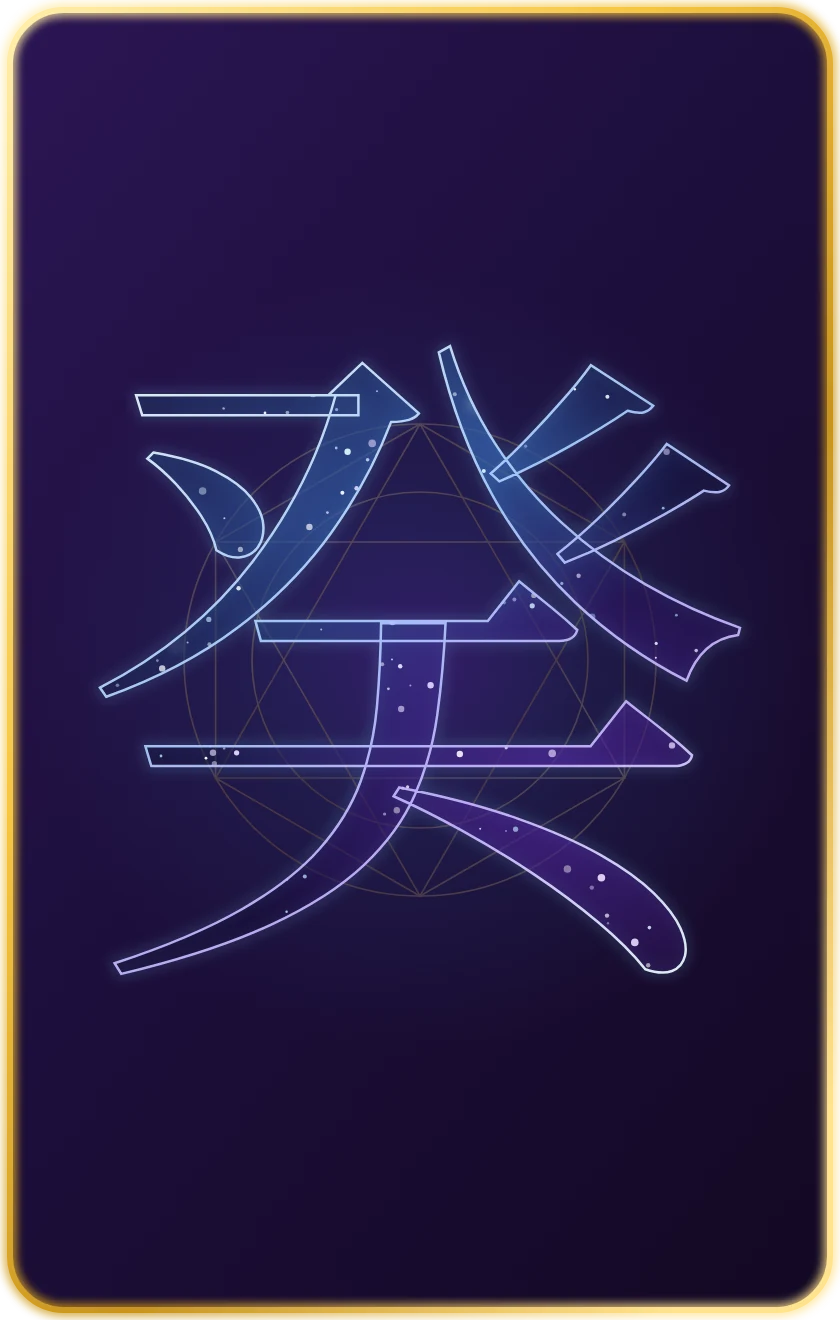
The stem and its image
Gui is the tenth and last of the heavenly stems, and its classical image is dew, fine rain. Two forms of the same water: the one that settles without having been seen coming, and the one that falls softly enough to damage nothing. Neither of them makes any noise, neither of them moves anything visible, and yet nothing resists them for long. A stone left out in fine rain ends up giving way, not through force but through duration.
The temperament that follows rests on penetration. Gui does not attack head on, it enters. It picks up inner states, unspoken tensions, what is going on underneath the conversation, and it gets there without having had to ask. That intuition has nothing spectacular about it: it is a continuous attention, which gathers in small quantities and ends up knowing a great deal.
Discretion follows naturally. Gui takes up little room, willingly lets itself be forgotten, lets others speak and retains everything. People often underestimate what it understands, precisely because it does not show it. Its patience is of the same order: it does not need a result now, it works in the long term and lets the situation ripen.
The reverse side is that of any fineness. The sensitivity the corpus attributes to it makes it permeable to what surrounds it: atmospheres pass through it, other people’s tensions settle on it like dew on whatever spends the night outside. Its difficulty is not feeling, it is knowing which part of what it feels really belongs to it.
Element and polarity
Gui carries Water in its Yin phase. The ten stems distribute the five elements into two phases each, and the Yang side of Water is the stem Ren, which comes immediately before Gui in the order of the ten. The two share the element without sharing the scale: Ren is the water that carries, Gui the water that seeps in.
Yin means neither weak nor feminine. It is a phase, not a gender: concentrated, turned inward, occupied with penetration rather than with extent. Yin Water is not measured by the volume it displaces but by what it reaches. One drop is enough if it falls long enough in the same place.
Where it hides
An earthly branch is never a simple block: it shelters one or more heavenly stems, called hidden stems, which give the pillar its real colour. Gui hides in two branches only.
In the branch Zi, that of the Rat, it stands in first rank. That is where it is at home: the branch offers it its purest ground, and the pillar takes on the silent fineness that characterises this stem.
In the branch Chou, that of the Ox, it stands in second rank. It does not lead there, it leaves a background moisture: a capacity for perception inside a branch that is not defined first of all by Water.
As Day Master
The stem of the day pillar carries a name of its own: it is the Day Master, the character from which everything else is read. To be born with Gui in that place is not to receive a destiny, it is to receive a way of perceiving.
A Gui Day Master moves by soaking things in rather than by abrupt decision. It observes, it waits, it understands a situation before stepping into it, and its influence is noticed afterwards more than in the moment. Its asset is seeing what is not said and holding out over time where others burn themselves out in one go. Its difficulty is letting itself be flooded by what it picks up, and mistaking patient waiting for deciding nothing.
What this stem indicates covers only one of the eight characters. The seven others, starting with the branch of the same day pillar, change how it comes out. That is also what separates this reading from the yearly Chinese horoscope: the year animal is likewise only one character out of eight, and it is not this one.
Keywords
- Intuition
- Penetration
- Discretion
- Sensitivity
- Patience