Meaning
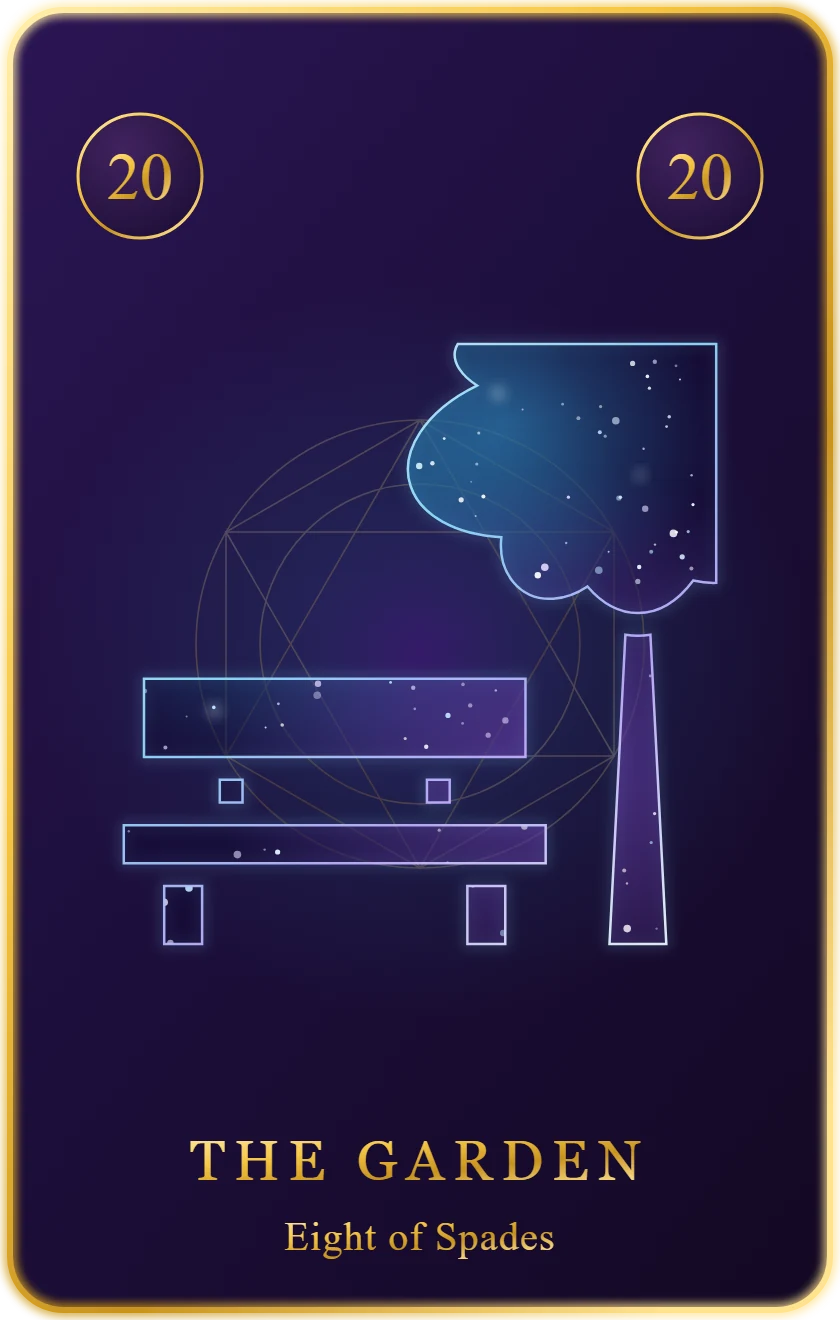
The Garden is card 20 of the Petit Lenormand, and its word is the public. Garden here must be heard as the public garden, the nineteenth century urban park: an open place where you stroll, where you cross paths with others, where you are on show. The card speaks neither of nature nor of gardening. It speaks of the space where you are seen.
Three common uses follow from that place. The first is the encounter: the Garden names the place and the moment when people cross paths, the event, the reception, the outing, the gathering. The second is the network: the whole set of people you know, the circle, the contacts, the community. The third is visibility: what is exposed to view, what becomes known, what circulates within a group.
On decks of the Dondorf line, around 1890, the card shows a park avenue lined with trimmed trees, sometimes with people walking. The detail to keep is the ordering: this is not a wild space, it is a social space, laid out to be frequented. The Garden is a collective setting, not a landscape.
The area of life concerned is therefore social life in the broad sense: outings, professional events, community activity, online presence, everything that happens in front of witnesses. The Garden marks the passage from the private to the collective.
When it qualifies its neighbour, the Garden adds the collective dimension to it: it makes public whatever the previous card designates. A matter becomes a known matter, a bond becomes a displayed bond, a piece of information becomes shared information. This is one of the most frequent uses of the card in a spread, and often the most useful.
A note on method. The card describes a setting, never a feeling. It says the scene is public, it does not say what is playing out there or how it ends. The content always comes from the neighbour, and the Garden alone gives one word only: in front of others.
Playing card and traditional reading
The Garden carries the inset of the Eight of Spades. This correspondence comes from the thirty-six card piquet deck that originally doubled the Petit Lenormand, and it is stable in the Dondorf line.
In the German school, the Spades suit points to what weighs, constrains or exposes. Applied to this card, it brings a nuance that naive readings forget: public space is not only convivial, it is also the place of other people’s eyes, of judgement and of rumour. Being seen is sometimes paid for by being talked about.
Some modern editions no longer print this inset. The correspondence remains valid for the reading, it is simply absent from the artwork.
Key combinations
The Lenormand is read in pairs, and the grammar is fixed: the first card is the noun, the second the qualifier. The Garden followed by the Fox designates the professional network. The Fox followed by the Garden designates work carried out in public. The pair cannot be reversed without changing meaning.
| Combination | Reading |
|---|---|
| The Garden + The Heart | A romantic encounter, a bond formed in public |
| The Garden + The Bouquet | A celebration, a festivity among people |
| The Garden + The Fox | The professional network, work contacts |
| The Garden + The Birds | A public conversation, a reputation going round |
| The Garden + The Tower | An official event, a public institutional setting |
The full mechanics of pairs are set out on the page about reading by combinations.
Position in the Grand Tableau
Position 20 in a Grand Tableau is the house of the Garden: the public, the place where you show yourself.
The card that lands there indicates what is playing out in front of others, or which circle surrounds the person. The Fox in the house of the Garden points to a work network, the Birds to conversations going round, the Tower to an official setting. When the Garden falls in its own house, the collective dimension dominates the reading.
The table of the thirty-six houses and the three tableau formats are set out on the page about the Grand Tableau.
Keywords
| Register | Words |
|---|---|
| Core meaning | The space where you are seen and where you meet |
| Public | Group, collective, assembly, in front of witnesses |
| Encounter | Event, outing, reception, gathering |
| Network | Circle, contacts, community, entourage |
| Visibility | Exposure, other people’s eyes, what becomes known |