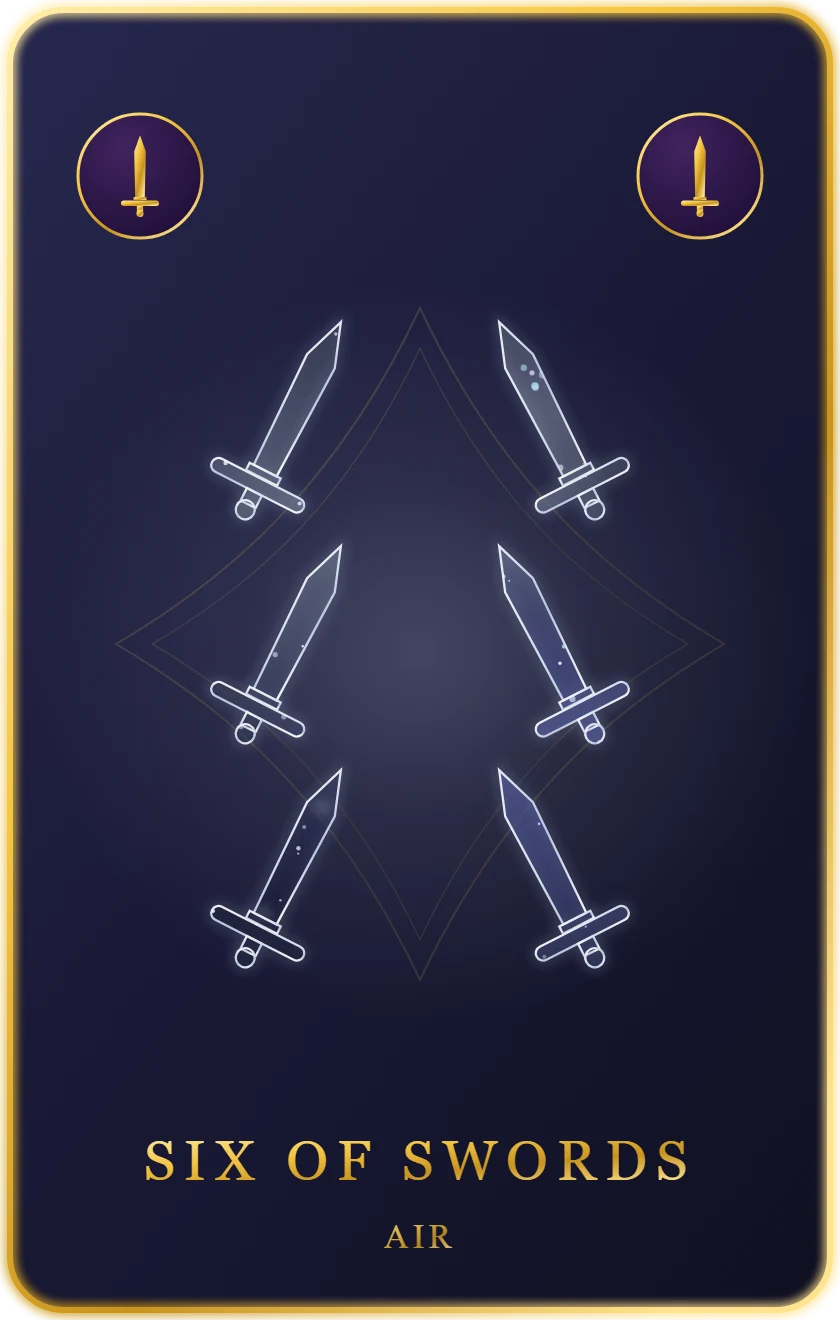
Meaning
The Six of Swords represents a major figure in human life: the intrinsic movement of things, the dialectic of becoming. It embodies this period of trial where the Swords transform and sharpen to better serve another destiny. Like in the myth of Prometheus forging iron for the gods, the Six of Swords symbolizes this inner forge, this profound realignment of mental and spiritual weapons before using them for greater well-being.
The traditional iconography of the Marseille Tarot shows a woman at the center with swords around her passing through the bathhouse with equal force. She embodies the firm will that accompanies this process of transformation. The Swords are tools of steel, not weapons of war. They will be used to build later, point by point.
In contemporary terms, this card evokes professional, geographical, or relational transitions where everything must be questioned for elevation. The Six of Swords is a kind of trial before the great challenge ahead, an intense period of training that will forge another destiny.
Reversed Meaning
When it appears reversed, the Six of Swords evokes a frozen transition, an insufficient adaptation to changes. The swords do not pass through the bathhouse but demobilize and atrophy. Will seems absent or wavering.
It is the card of forced relocation, where conditions of a new environment are imposed without proper preparation. As if one were fleeing, dispersing, scattering rather than focusing and sharpening. The Swords do not transform but deform.
The reversed Six calls to recognize those behaviors that hinder or deform, those reactions too weak in face of decline. It invites to question things not for elevation, but to avoid sinking.
Keywords
| Polarity | Keywords |
|---|---|
| Upright | Transition, inner forge, metamorphosis, firm will, adaptation |
| Reversed | Frozen transition, demobilization, atrophy, insufficient adaptation |
When this card appears in a reading
The Six of Swords appearing alone often announces a time for pause and reflection before a new departure. It invites self-questioning and preparing steel tools for what is to come.
In cross with another card, it indicates parallel work on oneself alongside an existing trial situation. The Six is the will that adjusts, the other card represents the challenge itself.
When it appears in a horseshoe (face side/back side) with another arcana, it generally indicates a two-step dynamic: first adjust your will through transition, then face a concrete challenge. As if one were molding oneself into a new certainty to confront the world.
In pyramid with three cards or more, it usually shows clear progression: 1/ internal adjustment, 2/ concrete action, 3/ result. The Six prepares a clean slate for what follows.