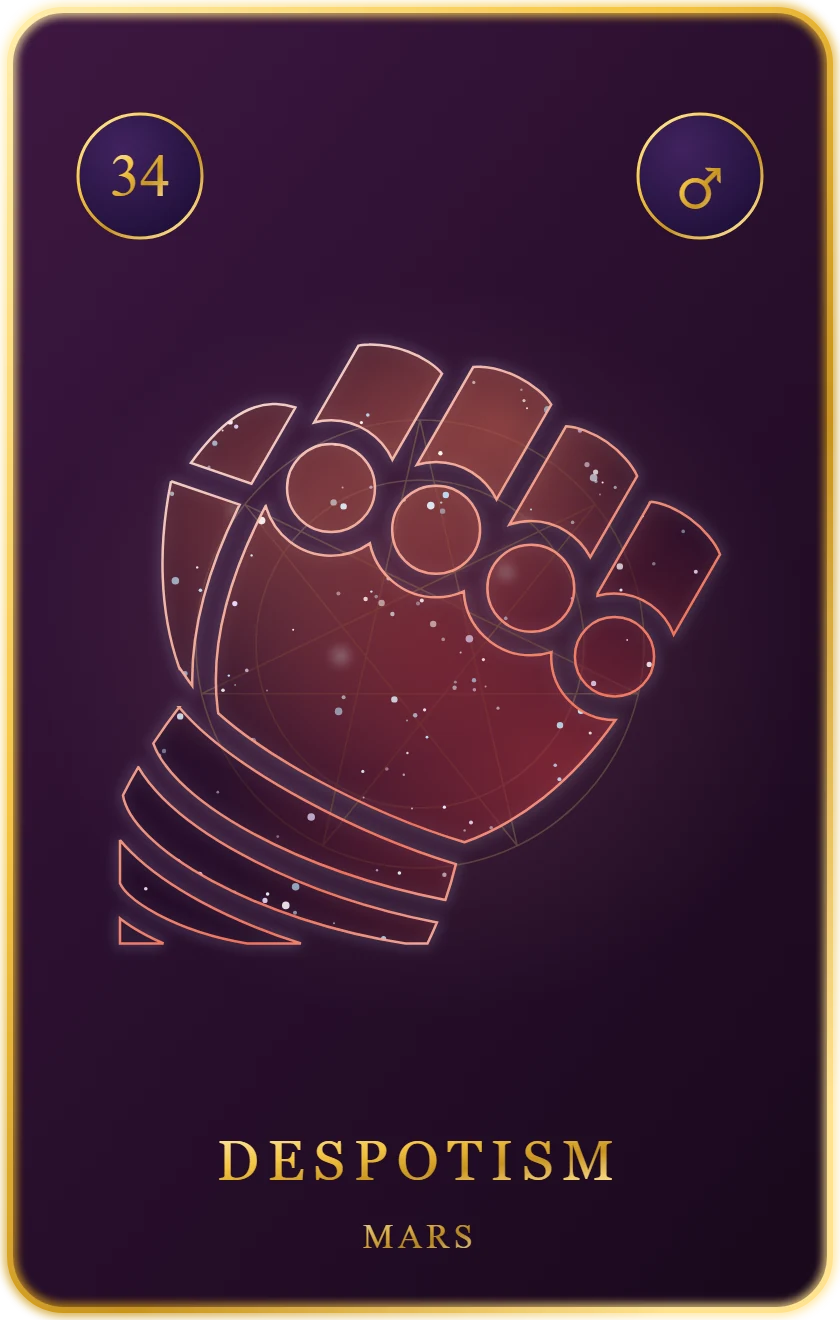
Meaning
Despotism names a power that crushes instead of guiding. The card points to abusive authority: pressure exerted from a position of strength, that oppresses rather than protects. Mars, here, does not attack head on. It weighs down, it imposes, it uses hierarchy as a lever rather than as a framework.
Despotism is card 34, in the Mars series (32 to 38). It follows Lawsuit (33), which formalises the conflict and brings it out of the private circle, and precedes Enemies (35), which names the adversary outright. Between these two cards, Despotism marks the stage where the balance of power sets in: disagreement is no longer discussed, it is imposed by whoever holds authority. Its opposite lies in the following series: Support (39, Jupiter) describes exactly the same position of strength, but turned toward protection rather than crushing. The two cards share the same power structure, with an inverted sign.
In a present day reading, Despotism points to a recognisable dynamic: a hierarchy that abuses its position, a professional or family relationship where one person’s word crushes everyone else’s, a pressure that cannot be discussed. The card does not say who is right, it names the imbalance of power at play, and invites distinguishing what belongs to a legitimate framework from what belongs to abuse.
The card is not only about the authority one endures: it sometimes sheds light on the authority one exercises without seeing it, a demand that has become rigid, a protection that has slid into control. Despotism does not condemn strength itself, it questions the direction in which it is exerted, toward the other’s movement or against it. Naming this shift is often enough to change its course, without a power imbalance resolving itself overnight.
Keywords
- Abusive authority
- Domination
- Hierarchical pressure
- Power imbalance
- Grip
- Crushing power
- Imposed rigidity
When this card appears in a reading
As a single card, drawn as advice for the moment, Despotism signals that a pressure coming from above deserves to be named before it is endured. It invites looking at who holds authority in the situation, and whether that authority still guides or has tipped into crushing.
In the four-card spread (you, your inner self, your relationships, your status), its position shifts the reading toward the domain concerned. In the “you” position, it questions the way you yourself exercise your own authority. In the “relationships” or “status” position, it points instead to a pressure endured, coming from a superior, an institution or someone close who imposes more than they share.
In the seven-card spread, its proximity to Lawsuit or Enemies reinforces the reading of a power conflict already under way, while its proximity to Support suggests that the same energy can still be redirected toward support rather than constraint. Despotism does not predict an outcome: it locates where the balance of power is being played out.